
Pearson+ LogoPearson+ Logo
Ch. 20 - The Molecular Revolution: Biotechnology, Genomics, and New Frontiers
Freeman - Biological Science 7th Edition
Freeman7th EditionBiological ScienceISBN: 9783584863285Not the one you use?Change textbook
Chapter 20, Problem 11

Potato blight causes potato plants to shrivel and rot. The disease is caused by the pathogen Phytophthora infestans, infamous for its role in Ireland's Great Potato Famine in the mid-1840s. The disease can devastate crops during wet weather, sometimes leading to total crop loss. Researchers aim to use recombinant DNA methods to transfer blight resistance genes from resistant varieties into susceptible varieties of potato. Explain how restriction endonucleases and DNA ligase could be used to insert a potato blight resistance gene into a plasmid.

Verified step by step guidance
1
Identify and isolate the gene responsible for blight resistance in a potato variety that is naturally resistant to Phytophthora infestans. This gene will be the segment of DNA that needs to be inserted into the susceptible potato variety.
Use restriction endonucleases to cut the DNA at specific recognition sites. These enzymes act as molecular scissors to cut both the DNA containing the blight resistance gene and the plasmid DNA at specific sequences, creating sticky ends or blunt ends.
Mix the cut plasmid DNA with the DNA fragment containing the blight resistance gene. The sticky ends of the plasmid DNA and the gene should complement each other, allowing them to anneal or join together through base pairing.
Add DNA ligase to the mixture. DNA ligase is an enzyme that facilitates the formation of phosphodiester bonds between adjacent nucleotides, effectively sealing the nicks in the sugar-phosphate backbone of the DNA. This step permanently integrates the blight resistance gene into the plasmid.
Introduce the recombinant plasmid into susceptible potato cells through a process such as transformation, where cells take up the plasmid from their environment. The cells can then be grown to develop into plants that express the blight resistance gene, thereby inheriting resistance to potato blight.

Verified video answer for a similar problem:

This video solution was recommended by our tutors as helpful for the problem above.
Video duration:
2m
Was this helpful?

Key Concepts

Here are the essential concepts you must grasp in order to answer the question correctly.

Restriction Endonucleases

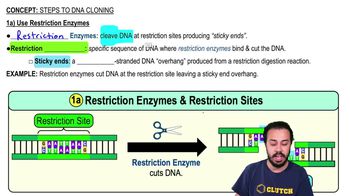
Restriction endonucleases, or restriction enzymes, are proteins that cut DNA at specific sequences, creating fragments with 'sticky' or 'blunt' ends. These enzymes are crucial in genetic engineering as they allow scientists to isolate specific genes, such as those conferring resistance to potato blight. By cutting both the plasmid and the target gene with the same restriction enzyme, compatible ends are generated, facilitating the insertion of the gene into the plasmid.
Recommended video:
Guided course
03:27
1a) Use Restriction Enzymes

DNA Ligase

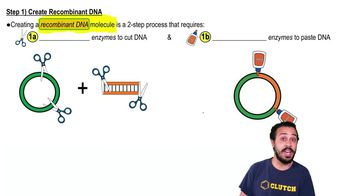
DNA ligase is an enzyme that facilitates the joining of DNA strands together by forming phosphodiester bonds. In the context of genetic engineering, after a gene of interest has been inserted into a plasmid, DNA ligase is used to seal the nicks in the sugar-phosphate backbone, ensuring that the plasmid is a continuous, stable piece of DNA. This step is essential for the successful incorporation of the resistance gene into the plasmid, allowing for its propagation in host cells.
Recommended video:
Guided course
02:09
Step 1) Create Recombinant DNA

Recombinant DNA Technology

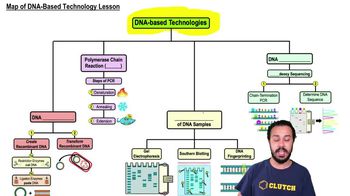
Recombinant DNA technology involves combining DNA from different sources to create new genetic combinations. This technique is pivotal in transferring desirable traits, such as disease resistance, into crops. By using restriction endonucleases to cut DNA and DNA ligase to join it, researchers can create plasmids that carry the blight resistance gene, which can then be introduced into susceptible potato varieties, enhancing their resilience against diseases like potato blight.
Recommended video:
Guided course
03:12
Map of DNA-Based Technology Lesson
Related Practice
Textbook Question

Revolutionaries executed Nicholas II, the last czar of Russia, along with his wife and five children, the family physician, and about a dozen servants. Many decades later, a grave said to hold the remains of the royal family was discovered. Biologists were asked to analyze DNA from the bodies. If the remains of the family were in this grave, predict how similar the DNA fingerprints would be between the parents, the children, and the unrelated individuals in the grave.

650
views
Textbook Question
Revolutionaries executed Nicholas II, the last czar of Russia, along with his wife and five children, the family physician, and about a dozen servants. Many decades later, a grave said to hold the remains of the royal family was discovered. Biologists were asked to analyze DNA from the bodies. If the remains of the family were in this grave, predict how similar the DNA fingerprints would be between the parents, the children, and the unrelated individuals in the grave.
844
views
Textbook Question

One hypothesis for differences between humans and chimpanzees involves differences in gene regulation. A study using RNA-seq showed that the overall patterns of gene expression were similar in the liver and blood of the two species, but the expression patterns were strikingly different in the brain. How do these results relate to the hypothesis?

843
views
Textbook Question
Potato blight causes potato plants to shrivel and rot. The disease is caused by the pathogen Phytophthora infestans, infamous for its role in Ireland's Great Potato Famine in the mid-1840s. The disease can devastate crops during wet weather, sometimes leading to total crop loss. Researchers aim to use recombinant DNA methods to transfer blight resistance genes from resistant varieties into susceptible varieties of potato.Explain how restriction endonucleases and DNA ligase could be used to insert a potato blight resistance gene into a plasmid.
790
views
Textbook Question
Potato blight causes potato plants to shrivel and rot. The disease is caused by the pathogen Phytophthora infestans, infamous for its role in Ireland's Great Potato Famine in the mid-1840s. The disease can devastate crops during wet weather, sometimes leading to total crop loss. Researchers aim to use recombinant DNA methods to transfer blight resistance genes from resistant varieties into susceptible varieties of potato.Transgenic plants usually contain genes of bacterial plasmid origin. In a recent study, researchers designed a strategy that avoided using any plasmid genes. They transformed cells from a susceptible potato variety with a potato blight resistance gene cloned from a resistant variety. Next, to determine which plants from this group were also free of plasmid DNA (cloning vector) sequences, they performed PCR using primers specific for the plasmid. The positive control lane shows PCR amplification of plasmid DNA only, and the negative control lane shows an attempted PCR amplification of no added DNA. Based on the gel analysis of PCR products shown below, which plants contain only the potato gene? Explain your answer.
893
views
Textbook Question

Potato blight causes potato plants to shrivel and rot. The disease is caused by the pathogen Phytophthora infestans, infamous for its role in Ireland's Great Potato Famine in the mid-1840s. The disease can devastate crops during wet weather, sometimes leading to total crop loss. Researchers aim to use recombinant DNA methods to transfer blight resistance genes from resistant varieties into susceptible varieties of potato. Transgenic plants usually contain genes of bacterial plasmid origin. In a recent study, researchers designed a strategy that avoided using any plasmid genes. They transformed cells from a susceptible potato variety with a potato blight resistance gene cloned from a resistant variety. Next, to determine which plants from this group were also free of plasmid DNA (cloning vector) sequences, they performed PCR using primers specific for the plasmid. The positive control lane shows PCR amplification of plasmid DNA only, and the negative control lane shows an attempted PCR amplification of no added DNA. Based on the gel analysis of PCR products shown below, which plants contain only the potato gene? Explain your answer.

627
views