Pearson+ LogoPearson+ Logo
Ch.3 - Protein Structure and Function
Freeman - Biological Science 7th Edition
Freeman7th EditionBiological ScienceISBN: 9783584863285Not the one you use?Change textbook
Chapter 3, Problem 5

If a cell were to use only 10 of the 20 possible amino acids, how much effect would you expect this to have on protein diversity? Calculate and compare the number of different sequences that can be generated by randomly assembling either 10 or 20 amino acids into peptides that are five residues long.

Verified step by step guidance
1
Identify the number of possible sequences for each scenario: To calculate the number of different sequences that can be generated, use the formula n^k, where n is the number of amino acids available and k is the length of the peptide. In this case, k = 5.
Calculate the number of sequences using 10 amino acids: Substitute n = 10 into the formula, so the calculation becomes 10^5.
Calculate the number of sequences using 20 amino acids: Substitute n = 20 into the formula, so the calculation becomes 20^5.
Compare the results: Calculate the ratio of the number of sequences possible with 20 amino acids to those possible with 10 amino acids to understand the impact on protein diversity.
Interpret the findings: A higher number of available amino acids significantly increases the diversity of possible peptide sequences, which can affect the structure and function of proteins in an organism.

Verified video answer for a similar problem:

This video solution was recommended by our tutors as helpful for the problem above.
Video duration:
1m
Was this helpful?

Key Concepts

Here are the essential concepts you must grasp in order to answer the question correctly.

Amino Acids and Proteins

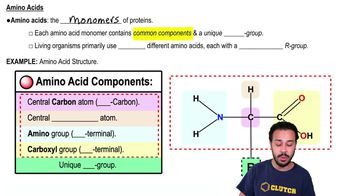
Amino acids are the building blocks of proteins, with 20 standard types that combine in various sequences to form polypeptides. The sequence and composition of amino acids determine a protein's structure and function, making the choice of amino acids critical for protein diversity.
Recommended video:

Combinatorial Mathematics

Combinatorial mathematics involves calculating the number of ways to arrange or combine items. In this context, it helps determine the number of unique peptide sequences that can be formed from a set number of amino acids, which is essential for understanding the impact of using fewer amino acids on protein diversity.
Recommended video:
Guided course
01:09
Introduction to Population Growth Models

Peptide Length and Sequence Variability

The length of a peptide, in this case, five residues, significantly influences the number of possible sequences. Each position in the peptide can be occupied by any of the available amino acids, leading to exponential growth in sequence variability as the number of amino acids increases, thereby affecting overall protein diversity.
Recommended video:
Guided course
01:03
Dideoxy Sequencing
Related Practice
Textbook Question

What type of bond is directly involved in the formation of an α-helix?

a. Peptide bonds between amino acid residues

b. Hydrogen bonds between amino acid residues

c. Van der Waals interactions between nonpolar residues

d. Disulfide bonds between cysteine residues

1770
views
Textbook Question

What type of information is used to direct different polypeptides to fold into different shapes?

1701
views
Textbook Question

Which of the following correctly describe an active site? Select True or False for each statement.

T/F It is the location in an enzyme where substrates bind.

T/F It is the place where a molecule or ion binds to an inactive enzyme to induce a shape change to make it active.

T/F It is the portion of an enzyme where chaperones bind to help enzymes fold.

T/F It is the site on an enzyme where catalysis occurs.

1903
views
Textbook Question

Explain how molecular chaperones facilitate protein folding in many different polypeptides, each with their own specific shape.

1581
views
Textbook Question

Why are proteins not considered to be a good candidate for the first living molecule?

a. Their catalytic capability is not sufficient for most biological reactions.

b. Their amino acid monomers were not likely present in the prebiotic soup.

c. They cannot serve as a template for replication.

d. They could not have polymerized from amino acid monomers under early Earth conditions.

2072
views
Textbook Question

Predict the effect on protein function if each polypeptide adopted only a single, inflexible shape based on its primary structure.

1655
views