Pearson+ LogoPearson+ Logo
Ch. 31 - Protostome Animals
Freeman - Biological Science 7th Edition
Freeman7th EditionBiological ScienceISBN: 9783584863285Not the one you use?Change textbook
Chapter 31, Problem 10

About a third of insect species measured are in decline, meaning that their populations are shrinking due to habitat destruction, pollution, and other factors. Predict how this change affects the bee pollination of crops such as apples and almonds.

Verified step by step guidance
1
Understand the role of bees in pollination: Bees are key pollinators for many crops, including apples and almonds. Pollination is the process where pollen is transferred from the male part of a flower (anther) to the female part (stigma), enabling fertilization and fruit production.
Recognize the impact of insect population decline: A decrease in bee populations due to habitat destruction, pollution, and other factors reduces the number of pollinators available to perform this essential function.
Analyze the consequences for crop production: With fewer bees available to pollinate crops, the efficiency of pollination decreases, potentially leading to lower yields of fruits like apples and almonds.
Consider secondary effects: Reduced crop yields can impact food supply, economic stability for farmers, and biodiversity in ecosystems that depend on these crops.
Predict long-term implications: If the decline in insect populations continues, it may necessitate alternative pollination strategies, such as manual pollination or reliance on other pollinator species, which could be less effective or more costly.

Verified video answer for a similar problem:

This video solution was recommended by our tutors as helpful for the problem above.
Video duration:
1m
Was this helpful?

Key Concepts

Here are the essential concepts you must grasp in order to answer the question correctly.

Pollination

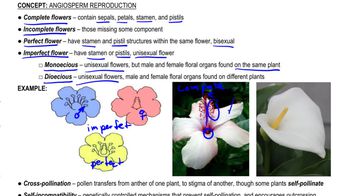
Pollination is the process by which pollen is transferred from the male anthers of a flower to the female stigma, enabling fertilization and the production of seeds. Insects, particularly bees, are crucial pollinators for many crops, including apples and almonds. Their activity directly influences fruit set and yield, making their decline a significant concern for agricultural productivity.
Recommended video:

Ecosystem Services

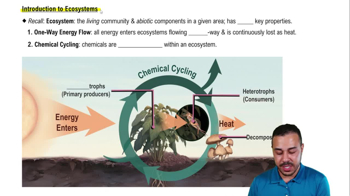
Ecosystem services are the benefits that humans derive from natural ecosystems, including food production, pollination, and climate regulation. Pollinators like bees provide essential services by facilitating the reproduction of flowering plants, which in turn supports food systems and biodiversity. A decline in pollinator populations can disrupt these services, leading to reduced crop yields and economic losses.
Recommended video:
Guided course
04:07
Introduction to Ecosystems

Biodiversity and Resilience

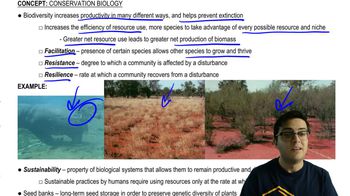
Biodiversity refers to the variety of life in a particular habitat or ecosystem, including the diversity of species, genetic variation, and ecosystem processes. High biodiversity contributes to ecosystem resilience, allowing systems to withstand environmental changes and disturbances. The decline of insect species, particularly pollinators, can reduce biodiversity, weakening ecosystem resilience and potentially leading to crop failures and food insecurity.
Recommended video:
Guided course
05:06
Biodiversity and Sustainability
Related Practice
Textbook Question

Brachiopoda is a phylum within the Lophotrochozoa. Even though they are not closely related to bivalve mollusks (such as clams or mussels), brachiopods look and act like bivalve mollusks. Specifically, brachiopods suspension feed, secrete calcium carbonate shells with two valves that hinge together in some species, and attach to rocks or other hard surfaces on the ocean floor. How is it possible for brachiopods and bivalves to be so similar if they did not share a recent common ancestor?

710
views
Textbook Question
Suppose that a gene originally identified in nematodes (roundworms) is found to be homologous with a gene that can cause developmental abnormalities in humans. Would it be possible to use fruit flies as a model organism to study this gene? Explain.
810
views
Textbook Question
Brachiopoda is a phylum within the Lophotrochozoa. Even though they are not closely related to bivalve mollusks (such as clams or mussels), brachiopods look and act like bivalve mollusks. Specifically, brachiopods suspension feed, secrete calcium carbonate shells with two valves that hinge together in some species, and attach to rocks or other hard surfaces on the ocean floor. How is it possible for brachiopods and bivalves to be so similar if they did not share a recent common ancestor?
1105
views
Textbook Question

A team of 102 scientists spent a year surveying a small area of the San Lorenzo rain forest in Panama to count the number of species of arthropods living there. After collecting 129,494 specimens—using nets, traps, shovels, tree-climbing harnesses, helium balloons, and other creative gear—it took the team eight years to sort and identify the arthropods. Which of the following nested groups best describes the taxonomic context for the San Lorenzo project?

a. Animalia > Bilateria > Arthropoda > Ecdysozoa

b. Protostomia > Lophotrochozoa > Ecdysozoa > Arthropoda

c. Arthropoda > Protostomia > Ecdysozoa > Bilateria

d. Bilateria > Protostomia > Ecdysozoa > Arthropoda

736
views
Textbook Question

A team of 102 scientists spent a year surveying a small area of the San Lorenzo rain forest in Panama to count the number of species of arthropods living there. After collecting 129,494 specimens—using nets, traps, shovels, tree-climbing harnesses, helium balloons, and other creative gear—it took the team eight years to sort and identify the arthropods. Rather than measuring the entire 6000-hectare (ha) forest, the researchers sampled arthropod diversity by intensively collecting as many arthropods as they could in 12 plots that measured 20 m × 20m square. If 1 ha=10,000 m², how many hectares of forest did they sample in all?

a. 20 m×20 m×12=4800 ha

b. 4800 m²×10,000 m²/1 ha=48,000,000 ha

c. 20 m×20 m=400 ha

d. 4800 m² x ha/10,000 m² = 0.48 ha

568
views
Textbook Question

A team of 102 scientists spent a year surveying a small area of the San Lorenzo rain forest in Panama to count the number of species of arthropods living there. After collecting 129,494 specimens—using nets, traps, shovels, tree-climbing harnesses, helium balloons, and other creative gear—it took the team eight years to sort and identify the arthropods. The graph below shows some of the data for the major arthropod groups collected. Notice that the scale on the y-axis is logarithmic to make both small and large numbers legible on the same graph. For example, there are about 400 species of spiders but only 40 species of bees.

About how many arthropods were found in total?

About what percentage of these were beetles?

661
views