Pearson+ LogoPearson+ Logo
Ch. 31 - Protostome Animals
Freeman - Biological Science 7th Edition
Freeman7th EditionBiological ScienceISBN: 9783584863285Not the one you use?Change textbook
Chapter 31, Problem 9

Suppose that a gene originally identified in nematodes (roundworms) is found to be homologous with a gene that can cause developmental abnormalities in humans. Would it be possible to use fruit flies as a model organism to study this gene? Explain.

Verified step by step guidance
1
Identify the gene of interest in nematodes and its homologous gene in humans that is associated with developmental abnormalities. Understanding the function and sequence of these genes is crucial.
Research whether the homologous gene exists in fruit flies (Drosophila melanogaster). This involves searching genetic databases or literature to find if there is a similar or identical gene in fruit flies.
Assess the conservation of the gene function across these species. Determine if the gene functions similarly in nematodes, humans, and fruit flies by reviewing functional studies or conducting experiments.
Develop or use existing genetic tools and techniques in fruit flies to manipulate the gene's expression or function. This could include gene knockout, overexpression, or using RNA interference.
Conduct experiments in fruit flies to observe the phenotypic outcomes of manipulating the gene. Compare these results with the known effects in humans and nematodes to draw conclusions about the gene's role in development.

Verified video answer for a similar problem:

This video solution was recommended by our tutors as helpful for the problem above.
Video duration:
2m
Was this helpful?

Key Concepts

Here are the essential concepts you must grasp in order to answer the question correctly.

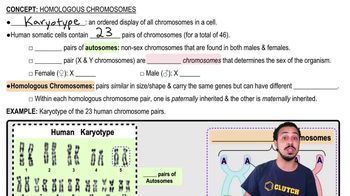
Homologous Genes

Homologous genes are genes that share a common ancestry, meaning they have evolved from a common ancestral gene. This similarity can be due to evolutionary processes such as gene duplication and divergence. Studying homologous genes across different species can provide insights into their functions and the biological processes they regulate, making them crucial for comparative biology.
Recommended video:
Guided course
08:09
Homologous Chromosomes

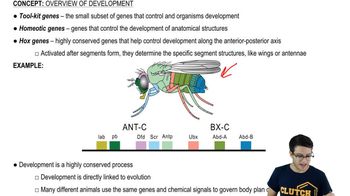
Model Organisms

Model organisms are non-human species that are extensively studied to understand biological processes, due to their simpler systems and genetic similarities to humans. Common model organisms include fruit flies (Drosophila melanogaster), mice, and nematodes. They allow researchers to conduct experiments that can be extrapolated to human biology, particularly in genetics and developmental biology.
Recommended video:
Guided course
01:09
Introduction to Population Growth Models

Developmental Biology

Developmental biology is the study of the process by which organisms grow and develop. It encompasses the genetic, cellular, and molecular mechanisms that govern development from a single cell to a complex organism. Understanding developmental pathways is essential for identifying how genes influence growth and abnormalities, making it relevant when studying homologous genes that affect development in different species.
Recommended video:
Related Practice
Textbook Question

Which of these choices is an example of homology (similarity due to common ancestry)?

a. Suspension feeding in sponges and clams

b. Ectoparasite lifestyle in aphids and ticks

c. Cnidocytes (stinging cells) in jellyfish and sea anemones

d. Radial symmetry in cnidarians and echinoderms

853
views
Textbook Question

Evaluate this statement: Evolution is said to occur when new traits accumulate over time, increasing complexity.

639
views
Textbook Question

Brachiopoda is a phylum within the Lophotrochozoa. Even though they are not closely related to bivalve mollusks (such as clams or mussels), brachiopods look and act like bivalve mollusks. Specifically, brachiopods suspension feed, secrete calcium carbonate shells with two valves that hinge together in some species, and attach to rocks or other hard surfaces on the ocean floor. How is it possible for brachiopods and bivalves to be so similar if they did not share a recent common ancestor?

710
views
Textbook Question
Brachiopoda is a phylum within the Lophotrochozoa. Even though they are not closely related to bivalve mollusks (such as clams or mussels), brachiopods look and act like bivalve mollusks. Specifically, brachiopods suspension feed, secrete calcium carbonate shells with two valves that hinge together in some species, and attach to rocks or other hard surfaces on the ocean floor. How is it possible for brachiopods and bivalves to be so similar if they did not share a recent common ancestor?
1105
views
Textbook Question

About a third of insect species measured are in decline, meaning that their populations are shrinking due to habitat destruction, pollution, and other factors. Predict how this change affects the bee pollination of crops such as apples and almonds.

1204
views
Textbook Question

A team of 102 scientists spent a year surveying a small area of the San Lorenzo rain forest in Panama to count the number of species of arthropods living there. After collecting 129,494 specimens—using nets, traps, shovels, tree-climbing harnesses, helium balloons, and other creative gear—it took the team eight years to sort and identify the arthropods. Which of the following nested groups best describes the taxonomic context for the San Lorenzo project?

a. Animalia > Bilateria > Arthropoda > Ecdysozoa

b. Protostomia > Lophotrochozoa > Ecdysozoa > Arthropoda

c. Arthropoda > Protostomia > Ecdysozoa > Bilateria

d. Bilateria > Protostomia > Ecdysozoa > Arthropoda

736
views