Pearson+ LogoPearson+ Logo
Ch. 32 - Deuterostome Animals
Freeman - Biological Science 7th Edition
Freeman7th EditionBiological ScienceISBN: 9783584863285Not the one you use?Change textbook
Chapter 32, Problem 12b

The size and shape of the vertebrate skull can reveal a great deal about an animal's lifestyle and evolutionary relationships. Consider your own skull. If you put your finger in your ear and move your jaw up and down, you can feel the space near the hinge of your jaw. Nestled in this space are the tiny bones that make your hearing possible: the malleus, incus, and stapes. All mammals have these three ear bones, but reptiles such as this T. rex don't. Where did ear bones come from? How is the opossum related to you?
Select True or False for each statement.
T/F An opossum is an animal, but I am a human.
T/F An opossum is a mammal, but I am a human.
T/F An opossum is a marsupial, but I am a placental mammal.
T/F The opossum and I are both tetrapods.

Verified step by step guidance
1
Step 1: Understand the classification of an opossum. An opossum is a marsupial, which is a type of mammal. Marsupials are characterized by giving birth to relatively undeveloped young, which often continue to develop in a pouch.
Step 2: Understand the classification of humans. Humans are placental mammals, which means they give birth to more developed young that have been nourished in the womb via a placenta.
Step 3: Recognize that both opossums and humans are mammals. Mammals are a class of animals that have characteristics such as hair and mammary glands.
Step 4: Recognize that both opossums and humans are tetrapods. Tetrapods are vertebrates with four limbs or limb-like appendages, which include mammals, birds, reptiles, and amphibians.
Step 5: Evaluate each statement based on the classifications: 1) An opossum is an animal, but I am a human. 2) An opossum is a mammal, but I am a human. 3) An opossum is a marsupial, but I am a placental mammal. 4) The opossum and I are both tetrapods.

Verified video answer for a similar problem:

This video solution was recommended by our tutors as helpful for the problem above.
Video duration:
1m
Was this helpful?

Key Concepts

Here are the essential concepts you must grasp in order to answer the question correctly.

Evolutionary Relationships

Evolutionary relationships refer to the connections between different species based on their common ancestry. These relationships are often depicted in phylogenetic trees, which illustrate how species have diverged from common ancestors over time. Understanding these relationships helps explain shared characteristics, such as the presence of three ear bones in mammals, and can clarify how different species, like humans and opossums, are related.
Recommended video:
02:45
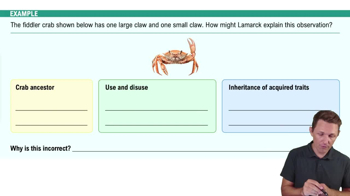
History of Evolutionary Theory Example 1

Mammalian Ear Bones

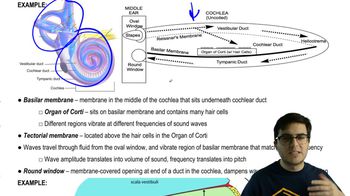
The malleus, incus, and stapes are three small bones in the middle ear of mammals that are crucial for hearing. These bones evolved from the jawbones of early vertebrates, highlighting a significant evolutionary adaptation. Their presence in all mammals, but not in reptiles like T. rex, underscores the evolutionary divergence between these groups and provides insight into the evolutionary history of mammals.
Recommended video:

Classification of Mammals

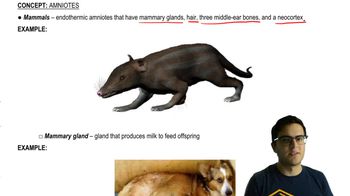
Mammals are classified into three main groups: monotremes, marsupials, and placental mammals. Marsupials, like opossums, give birth to underdeveloped young that typically continue to develop in a pouch. In contrast, placental mammals, such as humans, have a more extended gestation period within the womb. Despite these differences, both groups share common mammalian traits, including the presence of three ear bones, and are part of the larger group of tetrapods.
Recommended video:
Guided course
02:40
Mammals and Monotremes
Related Practice
Textbook Question

Genetic diversity in living human populations is highest in Africa and decreases as a function of distance traveled by the human migration that left Africa many millennia ago. Draw a graph to show this trend. (Hint: What is the independent variable? What is the dependent variable? What kind of graph is appropriate for this kind of data? Add a label where you would expect to find a data point for the Yanomamö tribe of the Amazon rain forest in South America. Why is it important to use indigenous people for this study?

983
views
Textbook Question

Humans possess which of the following traits? Select True or False for each trait. T/F triploblasty T/F parthenogenesis T/F viviparity T/F metamorphosis

715
views
Textbook Question

The size and shape of the vertebrate skull can reveal a great deal about an animal's lifestyle and evolutionary relationships. Consider your own skull. If you put your finger in your ear and move your jaw up and down, you can feel the space near the hinge of your jaw. Nestled in this space are the tiny bones that make your hearing possible: the malleus, incus, and stapes. All mammals have these three ear bones, but reptiles such as this T. rex don't.

Where did ear bones come from?

Analyze the morphological data shown here and write a hypothesis to explain the origin of mammalian ear bones. (The cynodont shown is one of many extinct synapsid amniotes that lived early in the lineage that gave rise to mammals.)

504
views
Textbook Question

The size and shape of the vertebrate skull can reveal a great deal about an animal's lifestyle and evolutionary relationships. Consider your own skull. If you put your finger in your ear and move your jaw up and down, you can feel the space near the hinge of your jaw. Nestled in this space are the tiny bones that make your hearing possible: the malleus, incus, and stapes. All mammals have these three ear bones, but reptiles such as this T. rex don't. Where did ear bones come from? The illustration of the opossum skull shows that the ear bones are completely separated from the jawbone (as they are in all mammals).

Pose a hypothesis to explain why this separation could be an adaptation that contributed to the radiation of mammals into diverse niches, including a nocturnal lifestyle.

644
views
Textbook Question

The size and shape of the vertebrate skull can reveal a great deal about an animal's lifestyle and evolutionary relationships. Consider your own skull. If you put your finger in your ear and move your jaw up and down, you can feel the space near the hinge of your jaw. Nestled in this space are the tiny bones that make your hearing possible: the malleus, incus, and stapes. All mammals have these three ear bones, but reptiles such as this T. rex don't. Where did ear bones come from? Gene expression patterns can be used to test hypotheses based on morphology. For example, the regulatory gene Bapx1 is expressed in the hinge of the developing lower jaw in fishes and reptiles.

Where would you predict Bapx1 expression to occur in mammals?

469
views
Textbook Question

The size and shape of the vertebrate skull can reveal a great deal about an animal's lifestyle and evolutionary relationships. Consider your own skull. If you put your finger in your ear and move your jaw up and down, you can feel the space near the hinge of your jaw. Nestled in this space are the tiny bones that make your hearing possible: the malleus, incus, and stapes. All mammals have these three ear bones, but reptiles such as this T. rex don't. Where did ear bones come from? Researchers studied mice embryos as a model organism to determine whether the cells of the ear bones originated from the same embryonic cells as the cells that form the jaw in other vertebrates.

Why would the researchers use mice instead of humans?

Do the results from mice tell you something about your own ears? Why or why not?

624
views