Pearson+ LogoPearson+ Logo
Ch. 39 - Animal Form and Function
Freeman - Biological Science 7th Edition
Freeman7th EditionBiological ScienceISBN: 9783584863285Not the one you use?Change textbook
Chapter 39, Problem 10

The dinosaur Apatosaurus (Brontosaurus) is one of the largest terrestrial animals that ever lived—over 20 m in length and weighing over 20 metric tons. Is it more likely that Apatosaurus was homeothermic or poikilothermic? Explain.

Verified step by step guidance
1
Understand the definitions: Homeothermic organisms maintain a stable internal body temperature regardless of external conditions, while poikilothermic organisms have a body temperature that varies with the environment.
Consider the size of Apatosaurus: Large animals have a lower surface area to volume ratio, which affects how they gain or lose heat. This could influence their thermoregulation strategy.
Evaluate the energy requirements: Homeothermic animals typically require more energy to maintain a constant body temperature, which could be challenging for such a large animal.
Analyze the environmental context: Consider the climate and habitat in which Apatosaurus lived. If it was warm and stable, poikilothermy might have been more feasible.
Reflect on evolutionary advantages: Determine if being homeothermic or poikilothermic would provide survival advantages, such as better mobility or adaptability to environmental changes.

Verified video answer for a similar problem:

This video solution was recommended by our tutors as helpful for the problem above.
Video duration:
1m
Was this helpful?

Key Concepts

Here are the essential concepts you must grasp in order to answer the question correctly.

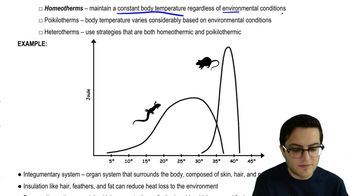
Homeothermy

Homeothermy refers to the ability of an organism to maintain a stable internal body temperature regardless of external environmental conditions. This is typically achieved through metabolic processes that generate heat, allowing animals to remain active in various climates. Homeothermic animals, like mammals and birds, often have adaptations such as insulation and efficient circulatory systems to support temperature regulation.
Recommended video:
Guided course
09:51
Thermoregulation

Poikilothermy

Poikilothermy is a condition where an organism's body temperature varies with the ambient environment. Poikilothermic animals, such as reptiles and amphibians, rely on external heat sources to regulate their body temperature, which can limit their activity during cooler periods. These animals often exhibit behaviors like basking in the sun to increase their body temperature and are generally less metabolically active than homeotherms.
Recommended video:
Guided course
09:51
Thermoregulation

Metabolic Rate and Size

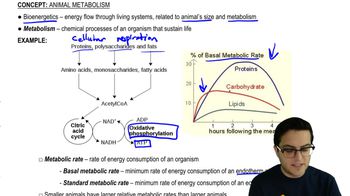
The metabolic rate of an organism is closely linked to its size, with larger animals typically having lower metabolic rates per unit of body mass. This concept is crucial in understanding thermoregulation in large dinosaurs like Apatosaurus. Due to their massive size, they may have had a slower metabolism, which could suggest a tendency towards poikilothermy, as maintaining a constant high metabolic rate would be energetically demanding for such large creatures.
Recommended video:
Guided course
07:08
Metabolic Rate
Related Practice
Textbook Question

Explain why most endotherms are homeothermic and most ectotherms are poikilothermic.

1029
views
Textbook Question

Consider three spheres with radii of 1 cm, 5 cm, and 10 cm.

Calculate the surface area and the volume of each sphere, and plot the results on a graph with radius on the x-axis and surface area and volume on the y-axis. (Surface area of a sphere = 4πr2; volume of a sphere = (4/3)πr3.)

Explain how the graph shows the relationship between size and surface area to volume ratio.

1340
views
Textbook Question

Explain why it would be impossible for a gorilla the size of King Kong to have fur. (Your answer should explain how the surface area to volume ratio of a normal-sized gorilla would compare to Kong's; relate this to the role of surface area and volume in heat generation and heat transfer, and consider the function of fur.)

664
views
Textbook Question

Many species of animals on islands are larger than related species on the mainland. Scientists hypothesize that this phenomenon, called island gigantism, evolved in response to the scarcity of competitors and predators on islands. Reduced competition and predation allow species to exploit more resources and free them from the need to hide in small refuges. The graph shown here compares the average carapace (shell) length of mainland and island tortoises. Summarize the results, then use the data to predict whether the surface area to volume ratio is higher in mainland or island tortoises.

637
views
Textbook Question

Many species of animals on islands are larger than related species on the mainland. Scientists hypothesize that this phenomenon, called island gigantism, evolved in response to the scarcity of competitors and predators on islands. Reduced competition and predation allow species to exploit more resources and free them from the need to hide in small refuges.

Which tortoises, mainland or island, need to eat more food per gram of their body mass?

573
views
Textbook Question

Many species of animals on islands are larger than related species on the mainland. Scientists hypothesize that this phenomenon, called island gigantism, evolved in response to the scarcity of competitors and predators on islands. Reduced competition and predation allow species to exploit more resources and free them from the need to hide in small refuges. Which of the following might be a trade-off of gigantism experienced by giant island tortoises?

a. They cool very rapidly during cold weather.

b. It would be difficult to sustain their high mass-specific metabolic rates on a diet of plants alone.

c. It could be more difficult to avoid thermally unfavorable conditions.

d. They could hide from nonnative predators more easily.

533
views