Pearson+ LogoPearson+ Logo
Ch. 39 - Animal Form and Function
Freeman - Biological Science 7th Edition
Freeman7th EditionBiological ScienceISBN: 9783584863285Not the one you use?Change textbook
Chapter 39, Problem 7

Explain why most endotherms are homeothermic and most ectotherms are poikilothermic.

Verified step by step guidance
1
Endotherms are organisms that generate heat internally through metabolic processes, which allows them to maintain a relatively constant body temperature regardless of external environmental conditions. This characteristic is known as homeothermy.
Homeothermy provides several advantages including the ability to inhabit a variety of environments, more consistent enzyme function, and the ability to remain active in a range of temperatures, which is why most endotherms are homeothermic.
Ectotherms, on the other hand, rely on external sources of heat to regulate their body temperature. This dependency makes their body temperature fluctuate with the ambient environment, a trait known as poikilothermy.
Poikilothermy in ectotherms is generally more energy-efficient as it requires less metabolic energy to maintain body temperature. However, it limits the range of environmental conditions they can tolerate and reduces their activity in colder temperatures.
Most ectotherms are poikilothermic because it is a more energy-efficient strategy for survival in stable or predictable thermal environments, where the benefits of energy saving outweigh the disadvantages of limited temperature tolerance.

Verified video answer for a similar problem:

This video solution was recommended by our tutors as helpful for the problem above.
Video duration:
1m
Was this helpful?

Key Concepts

Here are the essential concepts you must grasp in order to answer the question correctly.

Endothermy

Endotherms, or warm-blooded animals, maintain a constant internal body temperature regardless of external environmental conditions. This is achieved through metabolic processes that generate heat, allowing them to remain active in various climates. Examples include mammals and birds, which have adaptations such as insulation and behavioral strategies to regulate their temperature.
Recommended video:
Guided course
09:51
Thermoregulation

Ectothermy

Ectotherms, or cold-blooded animals, rely on external environmental temperatures to regulate their body heat. They do not have the metabolic mechanisms to maintain a stable internal temperature, leading to variations in activity levels based on the surrounding temperature. Common examples include reptiles and amphibians, which often bask in the sun to warm up or seek shade to cool down.
Recommended video:
Guided course
09:51
Thermoregulation

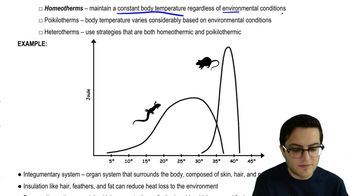
Homeothermy vs. Poikilothermy

Homeothermy refers to the ability of an organism to maintain a stable internal body temperature, characteristic of most endotherms. In contrast, poikilothermy describes organisms whose internal temperature fluctuates with the environment, typical of most ectotherms. This distinction is crucial for understanding how different animal groups adapt to their habitats and manage energy expenditure.
Recommended video:
Guided course
03:39
Dominant vs. Recessive Alleles
Related Practice
Textbook Question

Which of the following is an advantage that ectotherms have over endotherms of the same size?

a. They require much less food.

b. They are less vulnerable to predation during cold weather.

c. They can remain active in cold weather or on cold nights.

d. They have higher metabolic rates and grow more quickly.

832
views
Textbook Question

For each of the following, explain how structure relates to function:

absorptive sections of the digestive tract;

capillaries;

beaks of Galápagos finches;

fish gills.

652
views
Textbook Question

The metabolic rate of a frog in summer (at 35°C) is about eight times higher than in winter (at 5°C). Compare and contrast the frog's ability to move, exchange gases, and digest food at the two temperatures.

During which season will the frog require more food energy, and why?

848
views
Textbook Question

Consider three spheres with radii of 1 cm, 5 cm, and 10 cm.

Calculate the surface area and the volume of each sphere, and plot the results on a graph with radius on the x-axis and surface area and volume on the y-axis. (Surface area of a sphere = 4πr2; volume of a sphere = (4/3)πr3.)

Explain how the graph shows the relationship between size and surface area to volume ratio.

1340
views
Textbook Question

Explain why it would be impossible for a gorilla the size of King Kong to have fur. (Your answer should explain how the surface area to volume ratio of a normal-sized gorilla would compare to Kong's; relate this to the role of surface area and volume in heat generation and heat transfer, and consider the function of fur.)

664
views
Textbook Question

The dinosaur Apatosaurus (Brontosaurus) is one of the largest terrestrial animals that ever lived—over 20 m in length and weighing over 20 metric tons. Is it more likely that Apatosaurus was homeothermic or poikilothermic? Explain.

726
views