Pearson+ LogoPearson+ Logo
Ch. 39 - Animal Form and Function
Freeman - Biological Science 7th Edition
Freeman7th EditionBiological ScienceISBN: 9783584863285Not the one you use?Change textbook
Chapter 39, Problem 4

Which of the following is an advantage that ectotherms have over endotherms of the same size?
a. They require much less food.
b. They are less vulnerable to predation during cold weather.
c. They can remain active in cold weather or on cold nights.
d. They have higher metabolic rates and grow more quickly.

Verified step by step guidance
1
Understand the difference between ectotherms and endotherms: Ectotherms rely on external sources of heat to regulate their body temperature, while endotherms generate heat internally to maintain a constant body temperature.
Consider the energy requirements: Ectotherms generally require less energy because they do not need to maintain a constant internal temperature, which means they need less food compared to endotherms.
Evaluate the options given: Option a states that ectotherms require much less food, which aligns with the understanding that ectotherms have lower energy requirements.
Analyze the other options: Option b suggests ectotherms are less vulnerable to predation during cold weather, which is not typically true as they are less active in cold conditions. Option c suggests they can remain active in cold weather, which is contrary to their nature. Option d suggests higher metabolic rates, which is characteristic of endotherms, not ectotherms.
Conclude which option is correct based on the analysis: The advantage of requiring less food due to lower energy needs is a key benefit for ectotherms over endotherms of the same size.

Verified video answer for a similar problem:

This video solution was recommended by our tutors as helpful for the problem above.
Video duration:
36s
Was this helpful?

Key Concepts

Here are the essential concepts you must grasp in order to answer the question correctly.

Ectotherms vs. Endotherms

Ectotherms are organisms that rely on external environmental heat sources to regulate their body temperature, unlike endotherms, which generate heat metabolically. This distinction affects their energy requirements, behavior, and ecological niches. Ectotherms typically need less food than endotherms because they do not expend energy to maintain a constant body temperature.
Recommended video:
Guided course
03:39
Dominant vs. Recessive Alleles

Metabolic Rate

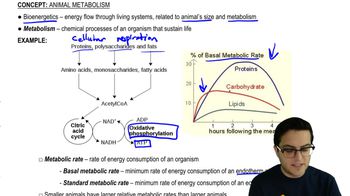
Metabolic rate refers to the rate at which an organism converts energy from food into energy for biological processes. Endotherms generally have higher metabolic rates than ectotherms, allowing them to maintain stable body temperatures and remain active in various environmental conditions. However, this also means they require more food to sustain their energy needs.
Recommended video:
Guided course
07:08
Metabolic Rate

Adaptations to Temperature

Ectotherms have adaptations that allow them to survive in environments with fluctuating temperatures, such as behavioral strategies like basking in the sun to increase body temperature. In contrast, endotherms can remain active in cold conditions due to their ability to internally regulate temperature, but this comes at the cost of higher energy consumption.
Recommended video:
05:24
Adaptive Radiation
Related Practice
Textbook Question

True or False: The increase in red blood cell count in tourists visiting Tibet is an example of acclimatization.

607
views
Textbook Question

Which of these examples best describes the concept that form facilitates function?

a. Crickets must balance their resources between spermatophore production and immune defenses.

b. A desert jackrabbit has large ears that help eliminate excess heat.

c. An Antarctic fish maintains homeostasis by conforming to the stable, external temperature.

d. Honeybees will swarm around a predatory wasp and contract their flight muscles to generate a lethal ball of heat.

699
views
Textbook Question

Which of the following statements regarding surface area and volume in animals are correct? Select True or False for each statement.

T/FAs an animal grows, its volume increases more rapidly than its surface area.

T/FA chihuahua has a higher surface area to volume ratio than a Great Dane.

T/FAnimals with high surface area to volume ratios heat and cool more slowly than animals with lower surface area to volume ratios.

T/FAs an animal's volume increases, its total surface area decreases.

794
views
Textbook Question

For each of the following, explain how structure relates to function:

absorptive sections of the digestive tract;

capillaries;

beaks of Galápagos finches;

fish gills.

652
views
Textbook Question

The metabolic rate of a frog in summer (at 35°C) is about eight times higher than in winter (at 5°C). Compare and contrast the frog's ability to move, exchange gases, and digest food at the two temperatures.

During which season will the frog require more food energy, and why?

848
views
Textbook Question

Explain why most endotherms are homeothermic and most ectotherms are poikilothermic.

1029
views