Pearson+ LogoPearson+ Logo
Ch. 43 - Animal Nervous Systems
Freeman - Biological Science 7th Edition
Freeman7th EditionBiological ScienceISBN: 9783584863285Not the one you use?Change textbook
Chapter 43, Problem 10

Alzheimer's disease is a common form of dementia affecting millions of people, especially the elderly. Two regions of the brain are particularly affected, often shrinking dramatically and accumulating large deposits of extracellular material. Based on your knowledge of memory, what two brain regions do you think these are? Explain.

Verified step by step guidance
1
Identify the brain regions involved in memory: The two primary brain regions involved in memory that are affected in Alzheimer's disease are the hippocampus and the cerebral cortex.
Understand the role of the hippocampus: The hippocampus is crucial for forming new memories. In Alzheimer's disease, this region often shrinks, which correlates with the symptoms of memory loss and disorientation experienced by patients.
Examine the impact on the cerebral cortex: The cerebral cortex is responsible for higher cognitive functions, including thinking, perceiving, and understanding language. In Alzheimer's, the degeneration of the cerebral cortex leads to difficulties in thinking and processing complex tasks.
Learn about the accumulation of extracellular material: In Alzheimer's disease, abnormal deposits of proteins form amyloid plaques and tau tangles in the brain, which are particularly prevalent in the hippocampus and cerebral cortex. These deposits disrupt cell function and communication.
Connect the symptoms with affected regions: By understanding which areas of the brain are affected and how, it becomes clearer why Alzheimer's disease leads to severe memory loss and cognitive decline, as these regions are integral to memory and cognitive processing.

Verified video answer for a similar problem:

This video solution was recommended by our tutors as helpful for the problem above.
Video duration:
1m
Was this helpful?

Key Concepts

Here are the essential concepts you must grasp in order to answer the question correctly.

Hippocampus

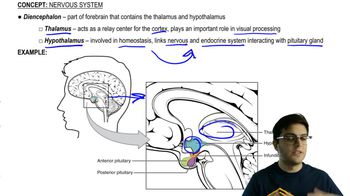
The hippocampus is a critical brain structure involved in the formation of new memories and spatial navigation. In Alzheimer's disease, this region often experiences significant atrophy, leading to difficulties in learning and recalling information. Its deterioration is one of the earliest signs of the disease, impacting both short-term and long-term memory.
Recommended video:
Guided course
04:35
Limbic System

Cerebral Cortex

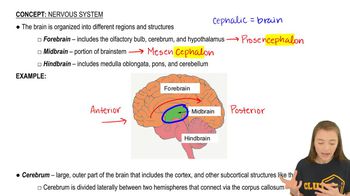
The cerebral cortex is the outer layer of the brain responsible for higher cognitive functions, including reasoning, problem-solving, and memory. In Alzheimer's disease, the cortex can shrink, particularly in areas associated with language and complex thought. This degeneration contributes to the cognitive decline and behavioral changes observed in affected individuals.
Recommended video:
Guided course
11:10
Cerebrum and Cerebral Cortex

Extracellular Deposits

Extracellular deposits, such as amyloid plaques, are abnormal protein aggregates found in the brains of Alzheimer's patients. These deposits disrupt cell communication and trigger inflammatory responses, leading to neuronal damage and death. The accumulation of these plaques is a hallmark of Alzheimer's disease and is closely linked to the progression of cognitive decline.
Recommended video:
Guided course
02:28
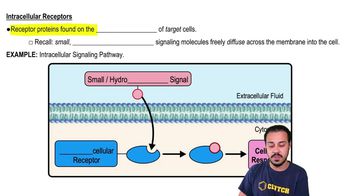
Intracellular Receptors
Related Practice
Textbook Question

Compare and contrast the somatic nervous system and autonomic nervous system.

1519
views
Textbook Question

Why is memory thought to involve changes in particular synapses?

a. At some synapses, more neurotransmitters are released after learning takes place.

b. At some synapses, a different type of neurotransmitter is released after learning takes place.

c. When researchers stimulated certain neurons electrically, individuals replayed memories.

d. When researchers changed synapses in the brains of patients during surgery, the patients' memories changed.

817
views
Textbook Question

Explain why drugs that prevent neurotransmitters from being taken back up by a presynaptic neuron have dramatic effects on the activity of postsynaptic neurons.

878
views
Textbook Question

Certain species of frogs in the genus Phyllobates have a powerful defensive adaptation—their skin can secrete a milky fluid that contains an extremely toxic compound called batrachotoxin (BTX). These frogs, which are found in Colombia, are known as poison dart frogs because some indigenous Colombian hunters coat the tips of their blowgun darts with the frogs' skin secretions. An animal hit by one of these darts dies quickly.

What is the mechanism of action of BTX? The graph here shows the effect of BTX on the membrane potential of a squid giant axon.

Which of the following is the most likely explanation for the effect of BTX on the squid giant axon?

a. Inactivation of Na+/K+-ATPase

b. Closing of sodium channels

c. Opening of sodium channels

d. Opening of potassium channels

854
views
Textbook Question

Certain species of frogs in the genus Phyllobates have a powerful defensive adaptation—their skin can secrete a milky fluid that contains an extremely toxic compound called batrachotoxin (BTX). These frogs, which are found in Colombia, are known as poison dart frogs because some indigenous Colombian hunters coat the tips of their blowgun darts with the frogs' skin secretions. An animal hit by one of these darts dies quickly.

What is the mechanism of action of BTX?

Identify a research technique that could be used to discover how BTX affects specific membrane proteins.

Based on the graph in Question 11, what would you expect this technique to show?

615
views
Textbook Question

Certain species of frogs in the genus Phyllobates have a powerful defensive adaptation—their skin can secrete a milky fluid that contains an extremely toxic compound called batrachotoxin (BTX). These frogs, which are found in Colombia, are known as poison dart frogs because some indigenous Colombian hunters coat the tips of their blowgun darts with the frogs' skin secretions. An animal hit by one of these darts dies quickly.

What is the mechanism of action of BTX? As the graph in Question 11 shows, BTX depolarizes the membrane and prevents repolarization.

What effect would this have on electrical signaling by the nervous system?

876
views