
Pearson+ LogoPearson+ Logo
Ch. 43 - Animal Nervous Systems
Freeman - Biological Science 7th Edition
Freeman7th EditionBiological ScienceISBN: 9783584863285Not the one you use?Change textbook
Chapter 43, Problem 5

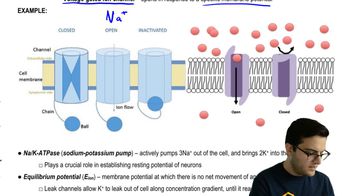
Explain the difference between a ligand-gated K+ channel and a voltage-gated K+ channel.

Verified step by step guidance
1
Understand the basic function of ion channels: Ion channels are proteins that allow ions to pass through the cell membrane, playing a crucial role in cell signaling and homeostasis.
Define ligand-gated channels: Ligand-gated channels open or close in response to the binding of a specific molecule, known as a ligand, which can be a neurotransmitter or hormone.
Define voltage-gated channels: Voltage-gated channels open or close in response to changes in the electrical potential across the cell membrane.
Compare the activation mechanisms: Ligand-gated K+ channels require the binding of a ligand to change their conformation and allow K+ ions to pass through, whereas voltage-gated K+ channels respond to changes in membrane potential to open or close.
Discuss the physiological roles: Ligand-gated K+ channels are often involved in synaptic transmission and cellular signaling, while voltage-gated K+ channels are crucial for action potential propagation and regulating neuronal excitability.

Verified video answer for a similar problem:

This video solution was recommended by our tutors as helpful for the problem above.
Video duration:
53s
Was this helpful?

Key Concepts

Here are the essential concepts you must grasp in order to answer the question correctly.

Ligand-Gated Ion Channels

Ligand-gated ion channels are a type of membrane protein that open or close in response to the binding of a specific chemical messenger, or ligand, such as a neurotransmitter. This binding alters the channel's conformation, allowing ions to pass through the membrane, which can initiate a cellular response. These channels are crucial in synaptic transmission and cellular signaling.
Recommended video:
Guided course
08:38
Ion Channels and Pumps

Voltage-Gated Ion Channels

Voltage-gated ion channels are membrane proteins that open or close in response to changes in the electrical potential across the cell membrane. These channels are essential for the propagation of action potentials in neurons and muscle cells, as they allow ions to flow in response to voltage changes, facilitating rapid communication and contraction processes.
Recommended video:
Guided course
08:38
Ion Channels and Pumps

Potassium Ion Channels

Potassium ion channels are a class of ion channels that selectively allow potassium ions (K+) to pass through the cell membrane. They play a critical role in maintaining the cell's resting membrane potential and in repolarizing the membrane after an action potential. The specific gating mechanism, whether ligand or voltage, determines how these channels are activated and contribute to cellular function.
Recommended video:
Guided course
08:38
Ion Channels and Pumps
Related Practice
Textbook Question

Which of these statements about myelination in neurons is/are correct? Select True or False for each statement.

T/FIt speeds propagation by increasing the density of voltage-gated channels all along the axon.

T/FMultiple sclerosis is characterized by disrupted myelination of certain neurons in the central nervous system.

T/FIt speeds propagation by preventing cations from leaking out across the membrane as they spread down the axon.

T/FIt is more commonly observed in vertebrates than in invertebrates.

1141
views
Textbook Question

In a neuron, what creates the electrochemical gradient favoring the outflow of K+ when the cell is at rest?

a. Na+/K+-ATPase

b. Voltage-gated K+ channels

c. Voltage-gated Na+ channels

d. Ligand-gated Na+/K+ channels

1060
views
Textbook Question

Which of the following brain regions is responsible for the formation of new memories?

a. Brainstem

b. Cerebellum

c. Frontal lobe

d. Hippocampus

1245
views
Textbook Question

Describe the role of summation in postsynaptic cells.

1008
views
Textbook Question

Compare and contrast the somatic nervous system and autonomic nervous system.

1519
views
Textbook Question

Why is memory thought to involve changes in particular synapses?

a. At some synapses, more neurotransmitters are released after learning takes place.

b. At some synapses, a different type of neurotransmitter is released after learning takes place.

c. When researchers stimulated certain neurons electrically, individuals replayed memories.

d. When researchers changed synapses in the brains of patients during surgery, the patients' memories changed.

817
views