Pearson+ LogoPearson+ Logo
Ch. 43 - Animal Nervous Systems
Freeman - Biological Science 7th Edition
Freeman7th EditionBiological ScienceISBN: 9783584863285Not the one you use?Change textbook
Chapter 43, Problem 2

Which of these statements about myelination in neurons is/are correct? Select True or False for each statement.
T/FIt speeds propagation by increasing the density of voltage-gated channels all along the axon.
T/FMultiple sclerosis is characterized by disrupted myelination of certain neurons in the central nervous system.
T/FIt speeds propagation by preventing cations from leaking out across the membrane as they spread down the axon.
T/FIt is more commonly observed in vertebrates than in invertebrates.

Verified step by step guidance
1
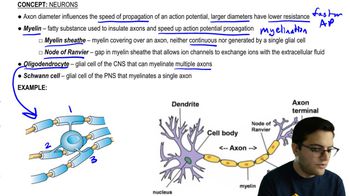
Understand the role of myelination in neurons: Myelination is the process by which a fatty layer, called myelin, accumulates around nerve fibers (axons). This layer acts as an insulator and is crucial for the efficient transmission of electrical signals along the neuron.
Evaluate the first statement: 'It speeds propagation by increasing the density of voltage-gated channels all along the axon.' Myelination actually reduces the need for voltage-gated channels along the axon, concentrating them at the nodes of Ranvier, which are gaps in the myelin sheath. This allows for faster signal transmission through saltatory conduction.
Consider the second statement: 'Multiple sclerosis is characterized by disrupted myelination of certain neurons in the central nervous system.' Multiple sclerosis is indeed a disease where the immune system attacks the myelin sheath in the central nervous system, leading to disrupted signal transmission.
Analyze the third statement: 'It speeds propagation by preventing cations from leaking out across the membrane as they spread down the axon.' Myelination prevents the leakage of ions, including cations, across the axonal membrane, which helps maintain the strength and speed of the electrical signal.
Review the fourth statement: 'It is more commonly observed in vertebrates than in invertebrates.' Myelination is a characteristic more commonly found in vertebrates, as it is a key adaptation for efficient nerve signal transmission in larger and more complex nervous systems.

Verified video answer for a similar problem:

This video solution was recommended by our tutors as helpful for the problem above.
Video duration:
2m
Was this helpful?

Key Concepts

Here are the essential concepts you must grasp in order to answer the question correctly.

Myelination and Signal Propagation

Myelination refers to the process by which a fatty layer, called myelin, accumulates around nerve fibers. This myelin sheath acts as an insulator, allowing electrical signals to travel more quickly and efficiently along the axon by preventing cations from leaking out. It facilitates saltatory conduction, where action potentials jump between nodes of Ranvier, rather than propagating continuously along the axon.
Recommended video:
Guided course
07:05
Myelin and Saltatory Conduction

Multiple Sclerosis and Myelination

Multiple sclerosis (MS) is an autoimmune disease that affects the central nervous system, characterized by the disruption of myelination. In MS, the immune system mistakenly attacks the myelin sheath, leading to impaired signal transmission, which can result in a variety of neurological symptoms. This demyelination disrupts the normal flow of electrical impulses, causing communication issues between the brain and the rest of the body.
Recommended video:
Guided course
07:05
Myelin and Saltatory Conduction

Myelination in Vertebrates vs. Invertebrates

Myelination is more commonly observed in vertebrates than in invertebrates. Vertebrates have evolved complex nervous systems that require rapid and efficient signal transmission, which is facilitated by myelinated axons. In contrast, invertebrates often rely on different mechanisms for nerve signal propagation, as their nervous systems are generally less complex and do not require the same level of speed and efficiency.
Recommended video: