
Textbook Question
Design experiments to test the hypothesis that electric eels are both electrogenic and electroreceptive.
796
views



 Verified step by step guidance
 04:46
04:46 04:46
04:46 04:25
04:25Design experiments to test the hypothesis that electric eels are both electrogenic and electroreceptive.
Honeybees live in social groups consisting of a queen, up to several hundred male drones, and thousands of infertile female workers. The drones mate with the queen only, and the workers protect the hive, forage, and feed and groom the queen. The health of the hive depends on the female workers performing these duties instead of reproducing.
What roles do pheromones play in maintaining a functional beehive?
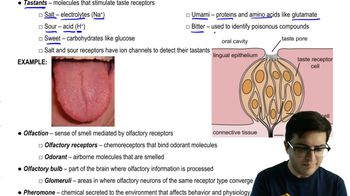
Scientists have identified dozens of pheromones used by honeybees for communication. Which type of sensory system uses pheromones?
a. Mechanoreception
b. Photoreception
c. Chemoreception
d. Thermoreception
e. Electroreception
Honeybees live in social groups consisting of a queen, up to several hundred male drones, and thousands of infertile female workers. The drones mate with the queen only, and the workers protect the hive, forage, and feed and groom the queen. The health of the hive depends on the female workers performing these duties instead of reproducing.
What roles do pheromones play in maintaining a functional beehive?
Honeybees produce an alarm pheromone when their hive is molested. This pheromone stimulates the bees to protect the hive. If you were to count the number of alarm pheromone receptors in honeybee tissues, which type of bee would likely have the most—a queen, a drone, or a worker? Why?
Honeybees live in social groups consisting of a queen, up to several hundred male drones, and thousands of infertile female workers. The drones mate with the queen only, and the workers protect the hive, forage, and feed and groom the queen. The health of the hive depends on the female workers performing these duties instead of reproducing.
What roles do pheromones play in maintaining a functional beehive?
Researchers observed that the queen produces a pheromone that attracts both drones and workers. They hypothesized that this pheromone inhibits ovarian development in the workers, making the workers infertile. To test this hypothesis, they exposed workers to a synthetic version of the queen pheromone and then recorded their 'ovary development score.' (Higher scores indicate more fully developed ovaries.) The results are shown in the graph here. Do these results support the researchers' hypothesis? Why or why not? (*** signifies P<0.001.)
Honeybees live in social groups consisting of a queen, up to several hundred male drones, and thousands of infertile female workers. The drones mate with the queen only, and the workers protect the hive, forage, and feed and groom the queen. The health of the hive depends on the female workers performing these duties instead of reproducing.
What roles do pheromones play in maintaining a functional beehive?
In the experiment described in Question 14, the researchers dissolved the queen pheromone in diethyl ether, a chemical that helps volatilize the pheromone, making it easier for the workers to detect it in the air. The control treatment consisted of plain diethyl ether. Why did they use this as the control instead of simply not exposing the workers to any chemical?
Honeybees live in social groups consisting of a queen, up to several hundred male drones, and thousands of infertile female workers. The drones mate with the queen only, and the workers protect the hive, forage, and feed and groom the queen. The health of the hive depends on the female workers performing these duties instead of reproducing.
What roles do pheromones play in maintaining a functional beehive?
Beekeepers carefully manage their beehives by adding mated queens, drones, and workers at appropriate times. However, sometimes the bees abandon a new hive before the queen can mature, and the result is inefficient hive management and honey production. Suggest a potential use of queen pheromone in controlling this problem.