
Pearson+ LogoPearson+ Logo
Ch. 48 - The Immune System in Animals
Freeman - Biological Science 7th Edition
Freeman7th EditionBiological ScienceISBN: 9783584863285Not the one you use?Change textbook
Chapter 48, Problem 10

Propose a hypothesis to explain how self-reactive B cells are identified and eliminated during maturation.

Verified step by step guidance
1
Step 1: Understand the concept of self-reactive B cells. These are B cells that mistakenly recognize and bind to the body's own tissues (self-antigens), which can potentially lead to autoimmune diseases.
Step 2: Recognize the importance of eliminating self-reactive B cells. The immune system must prevent these cells from becoming fully functional to maintain self-tolerance and prevent damage to the body's own tissues.
Step 3: Propose a hypothesis on the mechanism of elimination. One hypothesis could be that during B cell maturation in the bone marrow, self-reactive B cells receive strong signals through their B cell receptors (BCRs) when they bind to self-antigens present in the bone marrow.
Step 4: Consider the role of apoptosis in the elimination process. The hypothesis can include that these strong signals lead to the activation of apoptotic pathways, resulting in the programmed cell death of self-reactive B cells, thus preventing their maturation and entry into the peripheral immune system.
Step 5: Suggest a role for regulatory mechanisms. Another aspect of the hypothesis could be that certain regulatory cells or mechanisms in the bone marrow help to identify and induce apoptosis in self-reactive B cells, enhancing the selectivity of this elimination process.

Verified video answer for a similar problem:

This video solution was recommended by our tutors as helpful for the problem above.
Video duration:
3m
Was this helpful?

Key Concepts

Here are the essential concepts you must grasp in order to answer the question correctly.

B Cell Maturation

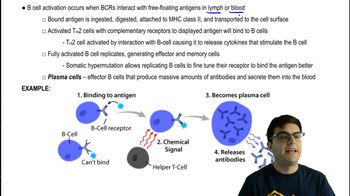
B cell maturation occurs in the bone marrow, where precursor cells develop into functional B cells. During this process, B cells undergo several stages, including heavy and light chain rearrangement, which allows them to produce unique antibodies. Proper maturation is crucial for ensuring that B cells can effectively recognize and respond to pathogens while avoiding self-reactivity.
Recommended video:
Guided course
04:06
Helper T Cells and B Cells

Negative Selection

Negative selection is a critical process during B cell maturation that eliminates self-reactive B cells. This occurs when immature B cells that bind strongly to self-antigens are induced to undergo apoptosis or are rendered anergic. This mechanism is essential for maintaining self-tolerance and preventing autoimmune diseases, as it ensures that only B cells capable of recognizing foreign antigens survive.
Recommended video:
Guided course
02:41
Negative Feedback

Central Tolerance

Central tolerance refers to the processes that occur in primary lymphoid organs, such as the bone marrow, to prevent the development of autoimmunity. In the context of B cells, central tolerance involves the elimination of self-reactive clones through negative selection. This concept is fundamental in understanding how the immune system distinguishes between self and non-self, thereby protecting the body from potential autoimmune responses.
Recommended video:
Guided course
05:45
Central Dogma
Related Practice
Textbook Question

Why is clonal selection necessary for the adaptive immune response but not the innate immune response? Select True or False for each statement.

T/F The adaptive immune response uses receptors to recognize pathogens, and the innate immune response does not.

T/F There is more receptor diversity in the adaptive immune response than in the innate immune response.

T/F Cells in the innate immune response do not require activation, and those in the adaptive immune response do.

T/F Clonal selection is used for targeting pathogens, and the innate immune response is used only to stop blood flow from the wound.

1079
views
Textbook Question

What would a vaccine have to contain to protect a patient from chicken pox? Explain why we don't have vaccines for HIV.

813
views
Textbook Question

Which of the following outcomes would be expected if somatic hypermutation did not occur?

a. The diversity of pattern-recognition receptors would be significantly lowered.

b. B and T lymphocytes would not be able to produce receptors that recognize antigens.

c. The adaptive immune response would not be activated by pathogens.

d. The secondary immune response to a repeat infection would produce the same antibodies as those made in the primary immune response.

715
views
Textbook Question

<Image>

In developed countries, an enormous change has occurred within the human body over the past century—the loss of parasitic worms. Due to improvements in sanitation, roundworms that have inhabited human intestines (such as the hookworm above) and challenged our immune system for millions of years are no longer a threat. Does the end of this long-term relationship come at a cost?

What is the hygiene hypothesis? What correlation does it attempt to explain?

762
views
Textbook Question

<Image>

In developed countries, an enormous change has occurred within the human body over the past century—the loss of parasitic worms. Due to improvements in sanitation, roundworms that have inhabited human intestines (such as the hookworm above) and challenged our immune system for millions of years are no longer a threat. Does the end of this long-term relationship come at a cost?

Explain how the adaptive and innate immune responses work together to defend the human body against infection by parasitic worms.

878
views
Textbook Question

<Image>

In developed countries, an enormous change has occurred within the human body over the past century—the loss of parasitic worms. Due to improvements in sanitation, roundworms that have inhabited human intestines (such as the hookworm above) and challenged our immune system for millions of years are no longer a threat. Does the end of this long-term relationship come at a cost?

Pattern-recognition receptors have been identified that recognize worm products. Explain how these receptors are used to activate the adaptive immune response most appropriate for worm infection.

963
views