

During the Carboniferous period, plant growth was extensive but rates of decomposition slowed (probably due to the formation of vast, oxygen-poor swamp habitats). As a result, large amounts of biomass accumulated in terrestrial environments (much of this biomass is now coal). The fossil record indicates that atmospheric oxygen increased, atmospheric carbon dioxide decreased, and global temperatures dropped. Explain why.
Scientists around the world are collaborating to understand how deforestation, climate change, and natural processes will interact to affect one of the most productive and biodiverse ecosystems on Earth.
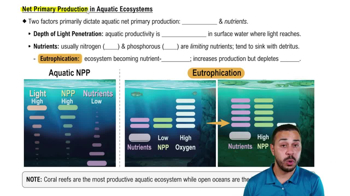
Researchers have measured the effects of periodic forest fires on primary productivity in Amazon rain forest plots, comparing years with average precipitation and years with severe drought. Propose which controls would be necessary for such studies.
Verified step by step guidance
Verified video answer for a similar problem:
Key Concepts
Primary Productivity
Deforestation
Experimental Controls
Scientists around the world are collaborating to understand how deforestation, climate change, and natural processes will interact to affect one of the most productive and biodiverse ecosystems on Earth.
Which of the following biomes typically has the highest net primary productivity?
a. Temperate forest
b. Tropical dry forest
c. Tropical grassland
d. Tropical wet forest
Scientists around the world are collaborating to understand how deforestation, climate change, and natural processes will interact to affect one of the most productive and biodiverse ecosystems on Earth.
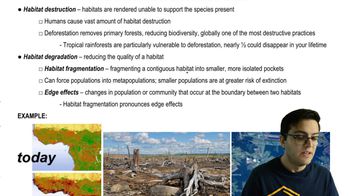
Select True or False for each statement about the effects of clear-cutting on the Amazon rain forest, then explain your reasoning.
T/F Nutrient export is likely to decline.
T/F Atmospheric CO2 is likely to decline.
T/F Soil moisture is likely to decline.
T/F Species diversity is likely to decline.
Scientists around the world are collaborating to understand how deforestation, climate change, and natural processes will interact to affect one of the most productive and biodiverse ecosystems on Earth.
This box-and-arrow model summarizes some of the feedback links observed in the Amazon rain forest. Select True or False for the statements that follow, based on whether they are represented by the model. (Note that the boxes and arrows in this model are used differently than those in the nutrient cycle models).
T/F The burning of fossil fuels increases atmospheric CO2.
T/F Tree growth reduces atmospheric CO2.
T/F The death of trees promotes the invasion of grasses.
T/F An increase in CO2 increases the frequency of droughts.
T/F Drought increases the frequency of forest fires.
Scientists around the world are collaborating to understand how deforestation, climate change, and natural processes will interact to affect one of the most productive and biodiverse ecosystems on Earth.
Many studies have raised the concern that positive feedback loops among numerous variables in the Amazon will cause an ecosystem tipping point—a rapid and irreversible transition from forest to grassland. Use the model in Question 14 as a tool to summarize a possible sequence of effects that could cause a transition from forest to grassland.
Scientists around the world are collaborating to understand how deforestation, climate change, and natural processes will interact to affect one of the most productive and biodiverse ecosystems on Earth. Journalists must be concise when reporting science news. Why might journalists and the public struggle to understand and discuss ecosystems ecology and global warming?
