
Pearson+ LogoPearson+ Logo
Ch. 53 - Ecosystems and Global Ecology
Freeman - Biological Science 7th Edition
Freeman7th EditionBiological ScienceISBN: 9783584863285Not the one you use?Change textbook
Chapter 53, Problem 15

Scientists around the world are collaborating to understand how deforestation, climate change, and natural processes will interact to affect one of the most productive and biodiverse ecosystems on Earth.
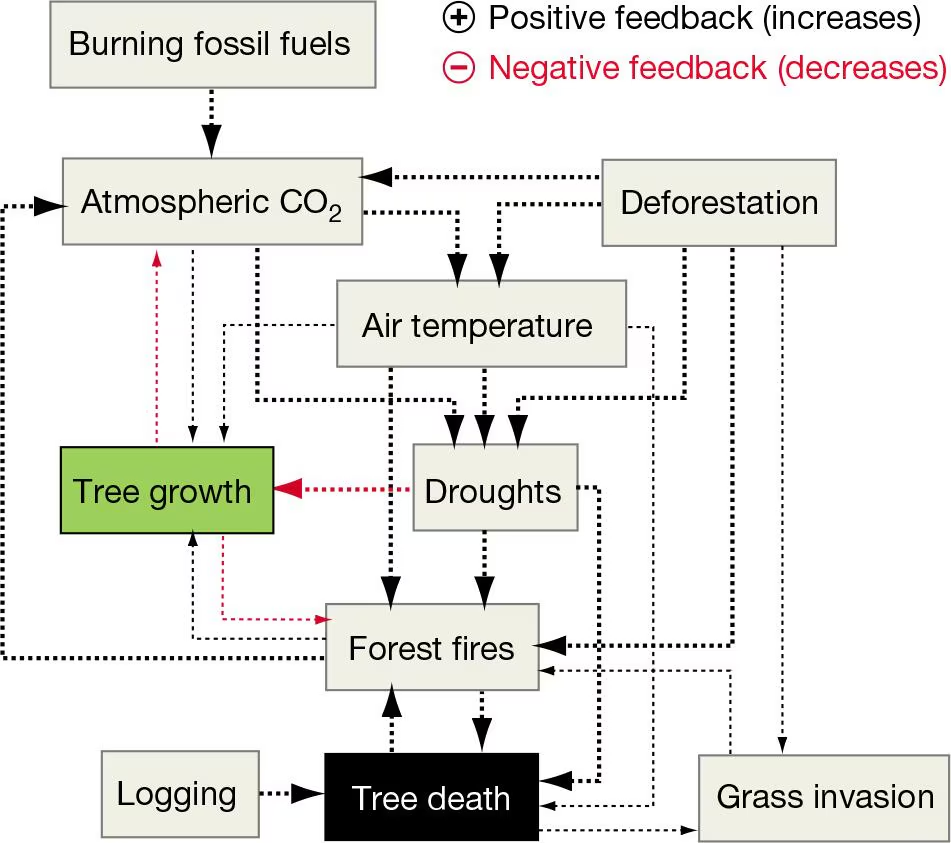
Many studies have raised the concern that positive feedback loops among numerous variables in the Amazon will cause an ecosystem tipping point—a rapid and irreversible transition from forest to grassland. Use the model in Question 14 as a tool to summarize a possible sequence of effects that could cause a transition from forest to grassland.
Flowchart showing interactions between deforestation, CO2, droughts, fires, and tree death leading to grass invasion.

Verified step by step guidance
1
Begin by identifying the key factors involved in the transition from forest to grassland, such as deforestation, climate change, and natural processes. Consider how each factor might contribute to changes in the ecosystem.
Examine the concept of positive feedback loops. These are processes where an initial change leads to effects that further amplify that change. In the context of the Amazon, consider how deforestation might reduce tree cover, leading to less moisture retention and higher temperatures, which in turn could further reduce tree cover.
Consider the role of climate change in this model. Increased temperatures and altered precipitation patterns can exacerbate the effects of deforestation, leading to drier conditions that favor grassland over forest.
Analyze how natural processes, such as fire, might interact with deforestation and climate change. Fires can be more frequent and intense in drier conditions, further reducing forest cover and promoting grassland expansion.
Summarize the sequence of effects: deforestation reduces tree cover, leading to drier conditions; climate change exacerbates these conditions; natural processes like fire further reduce forest cover, creating a positive feedback loop that accelerates the transition to grassland.

Verified video answer for a similar problem:

This video solution was recommended by our tutors as helpful for the problem above.
Video duration:
1m
Was this helpful?

Key Concepts

Here are the essential concepts you must grasp in order to answer the question correctly.

Deforestation

Deforestation refers to the large-scale removal of trees from forested areas, often to make way for agriculture or urban development. This process disrupts ecosystems, reduces biodiversity, and contributes to climate change by increasing carbon dioxide levels in the atmosphere. Understanding deforestation is crucial for analyzing its impact on the Amazon's transition from forest to grassland.
Recommended video:
Guided course
03:23
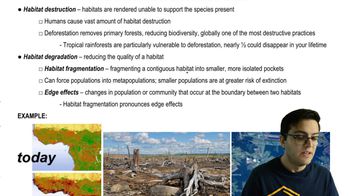
Habitat Destruction and Degradation

Positive Feedback Loops

Positive feedback loops occur when a change in a system causes further changes that amplify the initial effect, potentially leading to rapid and irreversible shifts. In the context of the Amazon, these loops might involve interactions between deforestation, climate change, and ecosystem dynamics, accelerating the transition from forest to grassland. Recognizing these loops is essential for predicting and mitigating ecosystem tipping points.
Recommended video:
Guided course
02:19
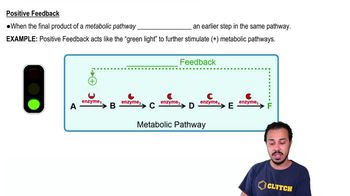
Positive Feedback

Ecosystem Tipping Points

Ecosystem tipping points are critical thresholds where a small change can lead to a significant and often irreversible transformation in the ecosystem's structure and function. In the Amazon, a tipping point might result in the conversion of forest to grassland, driven by factors like deforestation and climate change. Understanding tipping points helps in assessing the vulnerability and resilience of ecosystems under environmental stress.
Recommended video:
Guided course
04:07
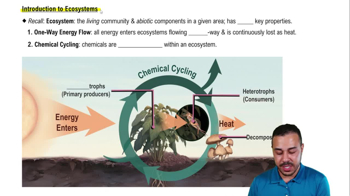
Introduction to Ecosystems
Related Practice
Textbook Question

Scientists around the world are collaborating to understand how deforestation, climate change, and natural processes will interact to affect one of the most productive and biodiverse ecosystems on Earth.

Select True or False for each statement about the effects of clear-cutting on the Amazon rain forest, then explain your reasoning.

T/F Nutrient export is likely to decline.

T/F Atmospheric CO2 is likely to decline.

T/F Soil moisture is likely to decline.

T/F Species diversity is likely to decline.

695
views
Textbook Question

Scientists around the world are collaborating to understand how deforestation, climate change, and natural processes will interact to affect one of the most productive and biodiverse ecosystems on Earth.

Researchers have measured the effects of periodic forest fires on primary productivity in Amazon rain forest plots, comparing years with average precipitation and years with severe drought. Propose which controls would be necessary for such studies.

549
views
Textbook Question

Scientists around the world are collaborating to understand how deforestation, climate change, and natural processes will interact to affect one of the most productive and biodiverse ecosystems on Earth.

This box-and-arrow model summarizes some of the feedback links observed in the Amazon rain forest. Select True or False for the statements that follow, based on whether they are represented by the model. (Note that the boxes and arrows in this model are used differently than those in the nutrient cycle models).

T/F The burning of fossil fuels increases atmospheric CO2.

T/F Tree growth reduces atmospheric CO2.

T/F The death of trees promotes the invasion of grasses.

T/F An increase in CO2 increases the frequency of droughts.

T/F Drought increases the frequency of forest fires.

609
views
Textbook Question

Scientists around the world are collaborating to understand how deforestation, climate change, and natural processes will interact to affect one of the most productive and biodiverse ecosystems on Earth. Journalists must be concise when reporting science news. Why might journalists and the public struggle to understand and discuss ecosystems ecology and global warming?

556
views