
Pearson+ LogoPearson+ Logo
Ch. 53 - Ecosystems and Global Ecology
Freeman - Biological Science 7th Edition
Freeman7th EditionBiological ScienceISBN: 9783584863285Not the one you use?Change textbook
Chapter 53, Problem 12

Scientists around the world are collaborating to understand how deforestation, climate change, and natural processes will interact to affect one of the most productive and biodiverse ecosystems on Earth.
Select True or False for each statement about the effects of clear-cutting on the Amazon rain forest, then explain your reasoning.
T/F Nutrient export is likely to decline.
T/F Atmospheric CO2 is likely to decline.
T/F Soil moisture is likely to decline.
T/F Species diversity is likely to decline.

Verified step by step guidance
1
Consider the impact of clear-cutting on nutrient export: Clear-cutting removes trees that play a crucial role in nutrient cycling. Without trees, nutrients are more likely to be washed away by rain, increasing nutrient export rather than declining it. Therefore, the statement 'Nutrient export is likely to decline' is False.
Evaluate the effect of clear-cutting on atmospheric CO2 levels: Trees absorb CO2 during photosynthesis, acting as carbon sinks. Clear-cutting reduces the number of trees, leading to less CO2 absorption and potentially increasing atmospheric CO2 levels. Thus, the statement 'Atmospheric CO2 is likely to decline' is False.
Analyze the impact of clear-cutting on soil moisture: Trees help maintain soil moisture through root systems that stabilize the soil and through transpiration, which contributes to local humidity. Removing trees can lead to increased soil erosion and reduced soil moisture. Therefore, the statement 'Soil moisture is likely to decline' is True.
Assess the effect of clear-cutting on species diversity: The Amazon rainforest is home to a vast array of species that rely on the complex ecosystem for survival. Clear-cutting disrupts habitats and can lead to a loss of species, reducing biodiversity. Hence, the statement 'Species diversity is likely to decline' is True.
Reflect on the interconnectedness of these factors: Clear-cutting in the Amazon rainforest affects multiple ecological processes, including nutrient cycling, carbon storage, soil moisture retention, and biodiversity. Understanding these interactions helps in assessing the broader environmental impact of deforestation.

Verified video answer for a similar problem:

This video solution was recommended by our tutors as helpful for the problem above.
Video duration:
1m
Was this helpful?

Key Concepts

Here are the essential concepts you must grasp in order to answer the question correctly.

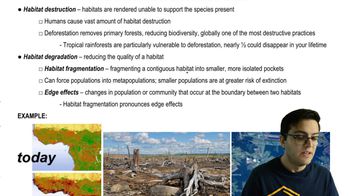
Deforestation

Deforestation refers to the large-scale removal of trees from forested areas, often to make way for agriculture or urban development. In the Amazon rainforest, clear-cutting disrupts the ecosystem by removing vegetation that plays a crucial role in nutrient cycling, carbon storage, and maintaining biodiversity. This process can lead to soil erosion, loss of habitat, and changes in local climate conditions.
Recommended video:
Guided course
03:23
Habitat Destruction and Degradation

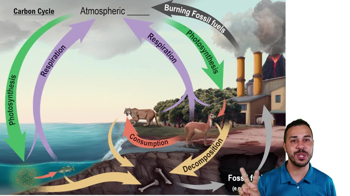
Carbon Cycle

The carbon cycle is the process by which carbon is exchanged between the atmosphere, land, and ocean. Forests, like the Amazon, act as carbon sinks, absorbing CO2 from the atmosphere through photosynthesis. Clear-cutting reduces the number of trees available to sequester carbon, potentially increasing atmospheric CO2 levels and contributing to climate change. Understanding this cycle is essential for assessing the impact of deforestation on global carbon dynamics.
Recommended video:

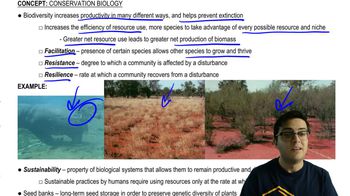
Biodiversity

Biodiversity refers to the variety of life forms within a given ecosystem, including species diversity, genetic diversity, and ecosystem diversity. The Amazon rainforest is one of the most biodiverse regions on Earth, home to countless species of plants, animals, and microorganisms. Clear-cutting can lead to habitat destruction, threatening species survival and reducing biodiversity, which can have cascading effects on ecosystem stability and resilience.
Recommended video:
Guided course
05:06
Biodiversity and Sustainability
Related Practice
Textbook Question

Suppose that record snows blanket your campus this winter. Your friend says this is proof that global warming isn't really occurring. What is the flaw in your friend's logic?

a. The average temperature of the Earth is not actually increasing.

b. Global warming refers to temperatures, but snow is a type of precipitation.

c. While the average global temperature is increasing, local temperatures and precipitation (weather) will vary.

d. Your friend is confusing global warming and global climate change.

833
views
Textbook Question

During the Carboniferous period, plant growth was extensive but rates of decomposition slowed (probably due to the formation of vast, oxygen-poor swamp habitats). As a result, large amounts of biomass accumulated in terrestrial environments (much of this biomass is now coal). The fossil record indicates that atmospheric oxygen increased, atmospheric carbon dioxide decreased, and global temperatures dropped. Explain why.

1270
views
Textbook Question

Scientists around the world are collaborating to understand how deforestation, climate change, and natural processes will interact to affect one of the most productive and biodiverse ecosystems on Earth.

Which of the following biomes typically has the highest net primary productivity?

a. Temperate forest

b. Tropical dry forest

c. Tropical grassland

d. Tropical wet forest

548
views
Textbook Question

Scientists around the world are collaborating to understand how deforestation, climate change, and natural processes will interact to affect one of the most productive and biodiverse ecosystems on Earth.

Researchers have measured the effects of periodic forest fires on primary productivity in Amazon rain forest plots, comparing years with average precipitation and years with severe drought. Propose which controls would be necessary for such studies.

549
views
Textbook Question

Scientists around the world are collaborating to understand how deforestation, climate change, and natural processes will interact to affect one of the most productive and biodiverse ecosystems on Earth.

This box-and-arrow model summarizes some of the feedback links observed in the Amazon rain forest. Select True or False for the statements that follow, based on whether they are represented by the model. (Note that the boxes and arrows in this model are used differently than those in the nutrient cycle models).

T/F The burning of fossil fuels increases atmospheric CO2.

T/F Tree growth reduces atmospheric CO2.

T/F The death of trees promotes the invasion of grasses.

T/F An increase in CO2 increases the frequency of droughts.

T/F Drought increases the frequency of forest fires.

609
views
Textbook Question

Scientists around the world are collaborating to understand how deforestation, climate change, and natural processes will interact to affect one of the most productive and biodiverse ecosystems on Earth.

Many studies have raised the concern that positive feedback loops among numerous variables in the Amazon will cause an ecosystem tipping point—a rapid and irreversible transition from forest to grassland. Use the model in Question 14 as a tool to summarize a possible sequence of effects that could cause a transition from forest to grassland.

567
views