Pearson+ LogoPearson+ Logo
Ch. 8 - Energy and Enzymes: An Introduction to Metabolism
Freeman - Biological Science 7th Edition
Freeman7th EditionBiological ScienceISBN: 9783584863285Not the one you use?Change textbook
Chapter 8, Problem 9

Draw a chemical equation to represent the redox reaction that occurs when methane (CH4) burns in the presence of oxygen (O2). Identify the reactant that is reduced and the reactant that is oxidized. Of the four molecules that should be in your equation, point out the one that has bonds with the highest potential energy.

Verified step by step guidance
1
Start by writing the chemical equation for the combustion of methane. The reactants are methane (CH₄) and oxygen (O₂), and the products are carbon dioxide (CO₂) and water (H₂O). The balanced equation is: CH₄ + 2O₂ → CO₂ + 2H₂O.
Identify the oxidation and reduction processes. In this reaction, methane (CH₄) is oxidized to carbon dioxide (CO₂), and oxygen (O₂) is reduced to water (H₂O).
Determine which reactant is oxidized. Methane (CH₄) loses electrons as it forms carbon dioxide (CO₂), meaning it is oxidized.
Determine which reactant is reduced. Oxygen (O₂) gains electrons as it forms water (H₂O), meaning it is reduced.
Identify the molecule with the highest potential energy bonds. Methane (CH₄) has C-H bonds, which are high-energy bonds compared to the bonds in the other molecules involved in this reaction.

Verified video answer for a similar problem:

This video solution was recommended by our tutors as helpful for the problem above.
Video duration:
4m
Was this helpful?

Key Concepts

Here are the essential concepts you must grasp in order to answer the question correctly.

Redox Reactions

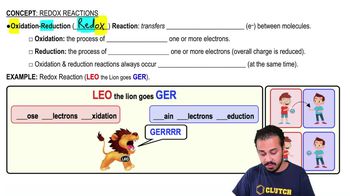
Redox reactions involve the transfer of electrons between two substances. In these reactions, one substance is oxidized (loses electrons) and another is reduced (gains electrons). Understanding which reactant is oxidized and which is reduced is crucial for analyzing the chemical changes occurring in the reaction.
Recommended video:
Guided course
04:47
Redox Reactions

Combustion of Methane

The combustion of methane (CH4) in the presence of oxygen (O2) is a redox reaction where methane is oxidized to carbon dioxide (CO2) and water (H2O) is formed. Methane loses electrons as it forms CO2, while O2 gains electrons to form H2O. This process releases energy, primarily in the form of heat.
Recommended video:
Guided course
08:52
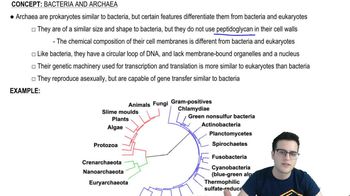
Prokaryotic Cell Structures 3

Potential Energy in Chemical Bonds

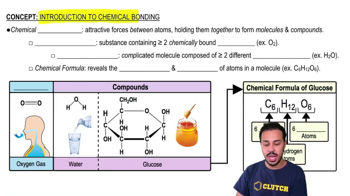
Chemical bonds store potential energy, which is released or absorbed during chemical reactions. In the combustion of methane, the C-H bonds in CH4 have higher potential energy compared to the bonds in the products (CO2 and H2O). This energy difference is what drives the reaction and results in the release of energy.
Recommended video:
Guided course
06:53
Introduction to Chemical Bonding
Related Practice
Textbook Question

If you were to expose glucose to oxygen on your lab bench, why would you not expect to see it burn as described by the reaction in Figure 8.6?

a. The reaction is endergonic and requires an input of energy.

b. The reaction is not spontaneous unless an enzyme is added.

c. The sugar must first be phosphorylated to increase its potential energy.

d. Activation energy is required for the sugar and oxygen to reach their transition state.

1372
views
Textbook Question

In Figure 8.10, the energetic coupling of substrate phosphorylation and an endergonic reaction are shown. If the hydrolysis of ATP releases 7.3 kcal of free energy, use the graph in this figure to estimate what you would expect the ∆G values to be for the uncoupled reaction and the two steps in the coupled reaction.


1739
views
Textbook Question

Using what you have learned about changes in Gibbs free energy, would you predict the ∆G value of catabolic reactions to be positive or negative? What about anabolic reactions? Justify your answers using the terms 'enthalpy' and 'entropy.'

2012
views
Textbook Question

You have discovered an enzyme that appears to function only when a particular sugar accumulates. Which of the following scenarios would you predict to be responsible for activating this enzyme?

a. The sugar cleaves the enzyme to form the active conformation.

b. The sugar is an allosteric regulatory molecule for the enzyme.

c. The sugar is a competitive inhibitor for the enzyme.

d. The sugar phosphorylates the enzyme to form the active conformation.

1556
views