Pearson+ LogoPearson+ Logo
Ch. 9 - Cellular Respiration and Fermentation
Freeman - Biological Science 7th Edition
Freeman7th EditionBiological ScienceISBN: 9783584863285Not the one you use?Change textbook
Chapter 9, Problem 1

Where does the citric acid cycle occur in eukaryotes?a. in the cytosol of cellsb. in the intermembrane space of mitochondriac. in the inner membrane of mitochondriad. in the matrix of mitochondria

Verified step by step guidance
1
Identify the location of the citric acid cycle, also known as the Krebs cycle, which is a key metabolic pathway that contributes to the energy supply of the cell.
Understand that the citric acid cycle involves a series of enzyme-catalyzed chemical reactions that are crucial for the production of ATP and other high-energy compounds.
Recognize that the mitochondrion is the organelle where the citric acid cycle occurs in eukaryotic cells.
Distinguish between the different parts of the mitochondrion: the outer membrane, the intermembrane space, the inner membrane, and the matrix.
Conclude that the specific location within the mitochondrion where the citric acid cycle takes place is the matrix.

Verified video answer for a similar problem:

This video solution was recommended by our tutors as helpful for the problem above.
Video duration:
1m
Was this helpful?

Key Concepts

Here are the essential concepts you must grasp in order to answer the question correctly.

Citric Acid Cycle (Krebs Cycle)

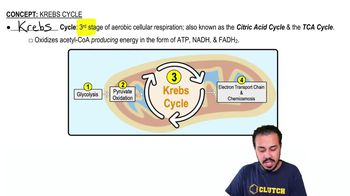
The citric acid cycle, also known as the Krebs cycle, is a series of chemical reactions used by all aerobic organisms to generate energy. It plays a crucial role in cellular respiration by oxidizing acetyl-CoA to produce ATP, NADH, and FADH2, which are essential for energy production in cells.
Recommended video:

Mitochondria Structure

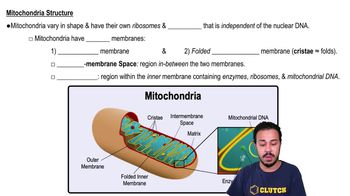
Mitochondria are double-membraned organelles found in eukaryotic cells, often referred to as the 'powerhouses' of the cell. They consist of an outer membrane, an inner membrane, and an internal space called the matrix, where the citric acid cycle occurs. Understanding the structure of mitochondria is essential for grasping where specific metabolic processes take place.
Recommended video:
Guided course
04:45
Mitochondria Structure

Cellular Respiration

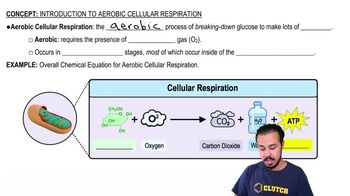
Cellular respiration is the metabolic process by which cells convert nutrients into energy, primarily in the form of ATP. It involves several stages, including glycolysis, the citric acid cycle, and oxidative phosphorylation. The citric acid cycle is a key component of this process, occurring in the mitochondrial matrix, where it contributes to the overall energy yield of the cell.
Recommended video:
Guided course
03:39
Introduction to Cellular Respiration