Skip to main content
Calculus
My Course
Learn
Exam Prep
AI Tutor
Study Guides
Textbook Solutions
Flashcards
Explore
Try the app
My Course
Learn
Exam Prep
AI Tutor
Study Guides
Textbook Solutions
Flashcards
Explore
Try the app
Back
Average Value of a Function definitions
You can tap to flip the card.
Definite Integral
You can tap to flip the card.
👆
Definite Integral
Represents the total area under a curve between two points, capturing accumulated change over an interval.
Track progress
Control buttons has been changed to "navigation" mode.
1/15
Related flashcards
Related practice
Recommended videos
Average Value of a Function quiz #1
Average Value of a Function
11 Terms
Average Value of a Function
8. Definite Integrals
5 problems
Topic
Ernest
Substitution
8. Definite Integrals
5 problems
Topic
Ernest
8. Definite Integrals - Part 1 of 2
5 topics
14 problems
Chapter
Ernest
8. Definite Integrals - Part 2 of 2
1 topic
3 problems
Chapter
Ernest
Guided course
04:25
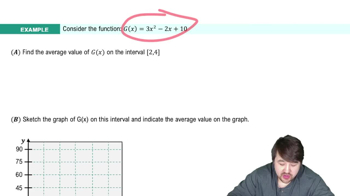
Average Value of a Function Example 1
487
views
19
rank
Guided course
06:37
Average Value of a Function
873
views
18
rank
1
comments
Terms in this set (15)
Hide definitions
Definite Integral
Represents the total area under a curve between two points, capturing accumulated change over an interval.
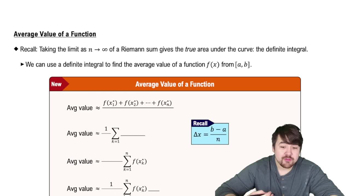
Average Value
Describes the mean output of a function across an interval, calculated using integration and interval length.
Interval
A continuous set of x-values, typically denoted by two endpoints, over which a function is analyzed.
Riemann Sum
An approximation method using sums of areas of rectangles to estimate the area under a curve.
Subinterval
A smaller segment within a larger interval, used to partition the domain for summation or integration.
Limit
A concept describing the value a sequence or function approaches as the input or index grows without bound.
Delta x
Represents the width of each subinterval in a partition, calculated as the total interval length divided by the number of subintervals.
Antiderivative
A function whose derivative yields the original function, used to compute definite integrals.
Fundamental Theorem of Calculus
Connects differentiation and integration, allowing evaluation of definite integrals using antiderivatives.
Bound
An endpoint of an interval, serving as a limit for integration or summation.
Summation
The process of adding a sequence of terms, often used to approximate integrals before taking limits.
Output
The value produced by a function for a given input, representing the function's response.
Input
A value substituted into a function, typically represented by x, determining the corresponding output.
Rectangle
A geometric shape used in Riemann sums to approximate areas under curves, defined by height and width.
Equation
A mathematical statement expressing the relationship between quantities, such as the formula for average value.
 BackBack
 04:25
04:25