Skip to main content
Calculus
My Course
Learn
Exam Prep
AI Tutor
Study Guides
Textbook Solutions
Flashcards
Explore
Try the app
My Course
Learn
Exam Prep
AI Tutor
Study Guides
Textbook Solutions
Flashcards
Explore
Try the app
Back
Common Functions quiz
You can tap to flip the card.
What is the domain and range of the constant function f(x) = c?
You can tap to flip the card.
👆
What is the domain and range of the constant function f(x) = c?
The domain is all real numbers, and the range is the single value c.
Track progress
Control buttons has been changed to "navigation" mode.
1/15
Related flashcards
Related practice
Recommended videos
Common Functions definitions
Common Functions
15 Terms
Common Functions
0. Functions
4 problems
Topic
Patrick
Transformations
0. Functions
3 problems
Topic
Ally
0. Functions - Part 1 of 2
7 topics
14 problems
Chapter
Patrick
0. Functions - Part 2 of 2
8 topics
12 problems
Chapter
David-Paige
7:42
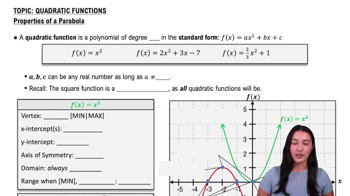
Properties of Parabolas
2046
views
54
rank
4:30
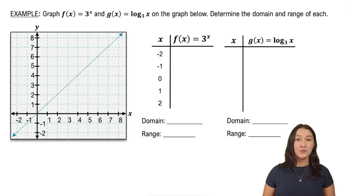
Graphing Logarithmic Functions Example 1
1328
views
49
rank
7:30
Logarithms Introduction
1614
views
48
rank
Terms in this set (15)
Hide definitions
What is the domain and range of the constant function f(x) = c?
The domain is all real numbers, and the range is the single value c.
What does the identity function f(x) = x output for any input x?
It outputs the same value as the input, so f(x) = x for all x.
What is the domain and range of the square function f(x) = x^2?
The domain is all real numbers, and the range is [0, ∞).
What shape does the graph of the square function f(x) = x^2 form?
It forms a parabola opening upwards.
What is the domain and range of the cube function f(x) = x^3?
Both the domain and range are all real numbers.
What is the domain and range of the square root function f(x) = √x?
The domain and range are [0, ∞).
What is the domain and range of the cube root function f(x) = ∛x?
Both the domain and range are all real numbers.
What is the slope-intercept form of a line and what do m and b represent?
The slope-intercept form is y = mx + b, where m is the slope and b is the y-intercept.
How do you find the y-intercept of a line from its graph?
The y-intercept is the y-value where the graph crosses the y-axis, at x = 0.
What is the standard form of a quadratic function and what is its graph called?
The standard form is f(x) = ax^2 + bx + c, and its graph is a parabola.
What is the axis of symmetry for a parabola and how is it related to the vertex?
The axis of symmetry is a vertical line passing through the vertex, dividing the parabola in half.
What are the requirements for a function to be a polynomial function?
All exponents must be positive whole numbers, and the graph must be smooth and continuous.
What is a rational function and how do you find its domain restrictions?
A rational function is a fraction of polynomials, and its domain excludes values that make the denominator zero.
What are the requirements for the base of an exponential function?
The base must be constant, positive, and not equal to 1.
How are logarithmic functions related to exponential functions, and how is their graph obtained?
Logarithmic functions are the inverse of exponential functions, and their graph is a reflection of the exponential graph over the line y = x.
 BackBack

 7:42
7:42