Skip to main content
Calculus
My Course
Learn
Exam Prep
AI Tutor
Study Guides
Textbook Solutions
Flashcards
Explore
Try the app
My Course
Learn
Exam Prep
AI Tutor
Study Guides
Textbook Solutions
Flashcards
Explore
Try the app
Back
Introduction to Limits definitions
You can tap to flip the card.
Limit
You can tap to flip the card.
👆
Limit
The y-value a function approaches as x gets arbitrarily close to a specific value, regardless of the function's value at that point.
Track progress
Control buttons has been changed to "navigation" mode.
1/15
Related flashcards
Related practice
Recommended videos
Introduction to Limits quiz #1
Introduction to Limits
16 Terms
Introduction to Limits
1. Limits and Continuity
5 problems
Topic
Ally
Finding Limits Algebraically
1. Limits and Continuity
4 problems
Topic
Ernest
1. Limits and Continuity
3 topics
7 problems
Chapter
Jonathan
03:33
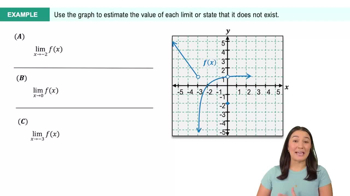
Cases Where Limits Do Not Exist Example 2
3179
views
84
rank
6:47
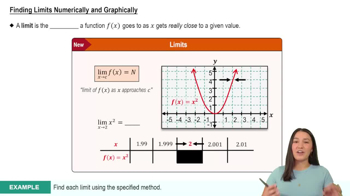
Finding Limits Numerically and Graphically
9686
views
356
rank
3
comments
03:07
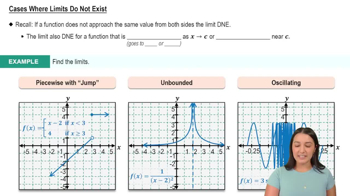
Cases Where Limits Do Not Exist
3493
views
81
rank
1
comments
Terms in this set (15)
Hide definitions
Limit
The y-value a function approaches as x gets arbitrarily close to a specific value, regardless of the function's value at that point.
One-sided Limit
The y-value a function approaches as x nears a specific value from only one direction, either left or right.
Left-sided Limit
The y-value a function approaches as x gets close to a specific value from values less than that point.
Right-sided Limit
The y-value a function approaches as x gets close to a specific value from values greater than that point.
Limit Notation
A symbolic way to express the value a function approaches as x nears a specific point, often using arrows and subscripts.
Piecewise Function
A function defined by different expressions over different intervals, often causing jumps or discontinuities.
Discontinuity
A point where a function is not continuous, often resulting in jumps, holes, or breaks in the graph.
Unbounded Behavior
A situation where a function increases or decreases without bound as x approaches a specific value, often heading to infinity.
Oscillation
A behavior where a function rapidly alternates between values as x approaches a point, preventing the limit from existing.
Asymptote
A line that a function approaches but never touches, often associated with unbounded behavior in limits.
Table of Values
A numerical method for estimating limits by evaluating the function at points increasingly close to the target x-value.
Graphical Method
A visual approach to finding limits by observing the trend of a function's graph near a specific x-value.
DNE
An abbreviation indicating that a limit does not exist due to differing one-sided limits, unbounded behavior, or oscillation.
Function Value
The actual output of a function at a specific input, which may differ from the value approached by the limit.
Infinity
A concept describing unbounded growth or decrease, not a real number, often appearing in limits with unbounded behavior.
 BackBack
 03:33
03:33