Skip to main content
Calculus
My Course
Learn
Exam Prep
AI Tutor
Study Guides
Textbook Solutions
Flashcards
Explore
Try the app
My Course
Learn
Exam Prep
AI Tutor
Study Guides
Textbook Solutions
Flashcards
Explore
Try the app
Back
Polar Coordinates definitions
You can tap to flip the card.
Polar Coordinate System
You can tap to flip the card.
👆
Polar Coordinate System
A plane system where points are determined by a distance from a central pole and an angle from a fixed axis.
Track progress
Control buttons has been changed to "navigation" mode.
1/15
Related flashcards
Related practice
Recommended videos
Polar Coordinates quiz
Polar Coordinates
15 Terms
Polar Coordinates
16. Parametric Equations & Polar Coordinates
5 problems
Topic
Ernest
Calculus in Polar Coordinates
16. Parametric Equations & Polar Coordinates
5 problems
Topic
Ernest
16. Parametric Equations & Polar Coordinates
5 topics
14 problems
Chapter
Justin
06:17
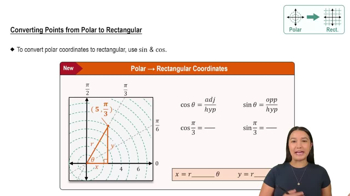
Convert Points from Polar to Rectangular
246
views
5
rank
2:21
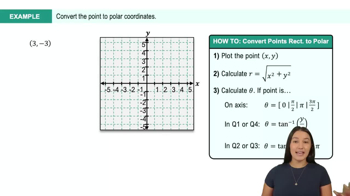
Convert Points from Rectangular to Polar Example 1
220
views
6
rank
3:03
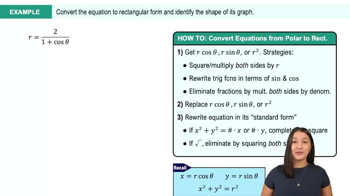
Convert Equations from Polar to Rectangular Example 2
200
views
2
rank
Terms in this set (15)
Hide definitions
Polar Coordinate System
A plane system where points are determined by a distance from a central pole and an angle from a fixed axis.
Pole
The central reference point in polar coordinates, analogous to the origin in rectangular coordinates.
Polar Axis
The fixed reference line from which angles are measured in polar coordinates, similar to the positive x-axis.
Ordered Pair
A notation (r, θ) representing a point's distance from the pole and its angle from the polar axis.
Coterminal Angles
Angles that share the same terminal side, found by adding or subtracting multiples of 2π.
Rectangular Coordinates
A system using (x, y) pairs to locate points based on horizontal and vertical distances from the origin.
Conversion Equations
Formulas x = r cos(θ) and y = r sin(θ) used to switch between polar and rectangular coordinates.
Pythagorean Theorem
A relationship used to find the radius in polar form: r² = x² + y².
Tangent Function
A trigonometric ratio used to find the angle in polar form: tan(θ) = y/x.
Cardioid
A heart-shaped polar graph with equation r = a ± a cos(θ) or r = a ± a sin(θ).
Limacon
A polar graph with equation r = a ± b cos(θ) or r = a ± b sin(θ), where a ≠ b, producing dimples or loops.
Rose
A polar graph with petal patterns, given by r = a cos(nθ) or r = a sin(nθ), where n determines petal count.
Lemniscate
A figure-eight shaped polar graph with equation r² = a² cos(2θ) or r² = a² sin(2θ).
Symmetry
A property indicating whether a polar graph mirrors across the polar axis, θ = π/2, or the pole.
Quadrantal Angles
Key angles (0, π/2, π, 3π/2) used for plotting and analyzing points in polar graphs.
 BackBack
 06:17
06:17