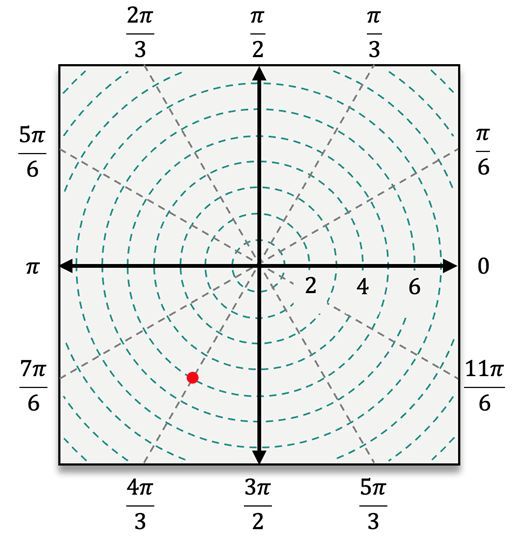
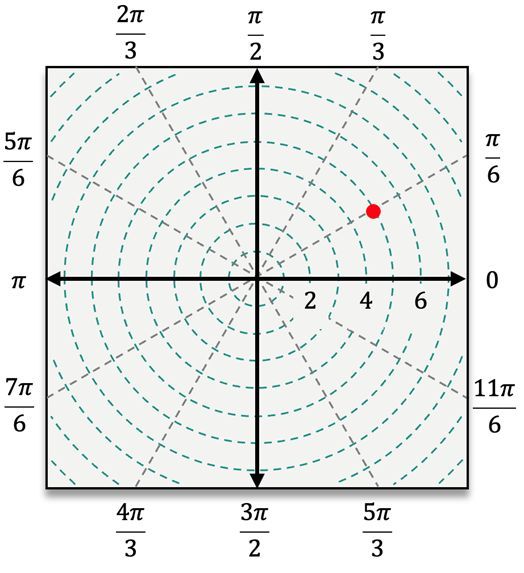
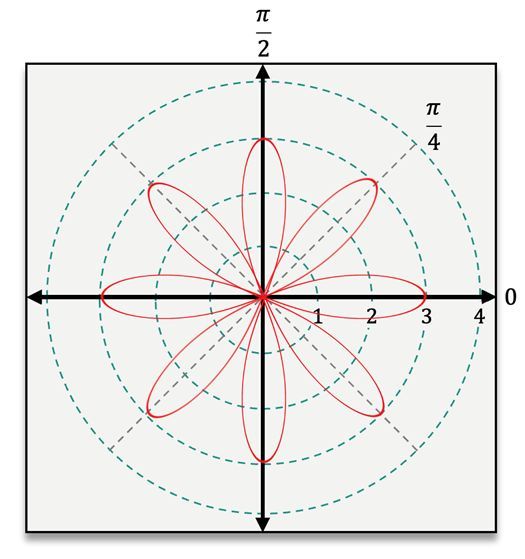
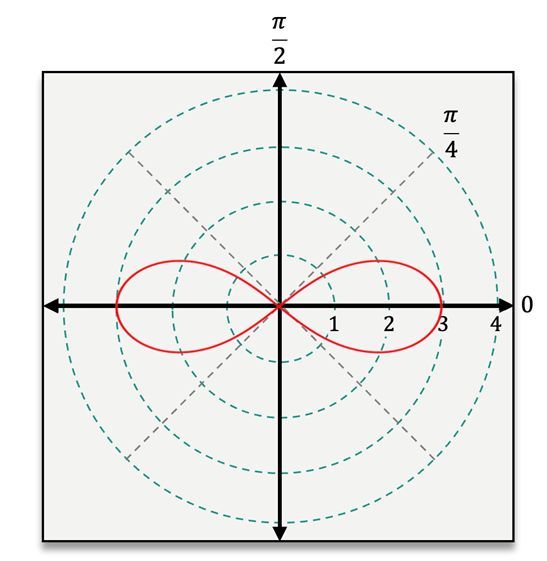
In mathematics, the polar coordinate system offers a unique way to plot points using the parameters \( r \) and \( \theta \), as opposed to the traditional Cartesian coordinates of \( x \) and \( y \). In this system, \( r \) represents the distance from the pole (the origin, or point \( (0,0) \)), while \( \theta \) denotes the angle measured from the polar axis, which corresponds to the positive x-axis in Cartesian coordinates.
To understand polar coordinates, it is essential to visualize the system. The pole is located at \( r = 0 \), and as \( r \) increases, it indicates points further away from the pole. The angle \( \theta \) is measured counterclockwise from the polar axis, similar to how angles are measured on the unit circle. For example, an angle of \( \frac{\pi}{2} \) radians corresponds to the positive y-axis.
When plotting a point in polar coordinates, the ordered pair is written as \( (r, \theta) \). For instance, to plot the point \( (5, \frac{\pi}{6}) \), one would first locate the angle \( \frac{\pi}{6} \) on the polar coordinate system and then move outwards from the pole a distance of 5 units.
Negative angles in polar coordinates indicate a clockwise measurement from the polar axis. For example, to plot the point \( (5, -\frac{\pi}{3}) \), one would measure \( \frac{\pi}{3} \) radians clockwise from the polar axis and then count 5 units away from the pole to plot the point.
Additionally, when the radius \( r \) is negative, it signifies a movement in the opposite direction along the line defined by the angle \( \theta \). For example, to plot the point \( (-3, \frac{\pi}{6}) \), one would first locate the angle \( \frac{\pi}{6} \) and then count 3 units in the opposite direction from the pole.
Understanding the signs of both \( r \) and \( \theta \) is crucial when working with polar coordinates, as they dictate the direction and distance from the pole. This system is particularly useful for representing circular and rotational patterns, making it a valuable tool in various fields of mathematics and physics.