Skip to main content
Calculus
My Course
Learn
Exam Prep
AI Tutor
Study Guides
Textbook Solutions
Flashcards
Explore
Try the app
My Course
Learn
Exam Prep
AI Tutor
Study Guides
Textbook Solutions
Flashcards
Explore
Try the app
Back
Tangent Lines and Derivatives definitions
1 student found this helpful
You can tap to flip the card.
Secant Line
You can tap to flip the card.
👆
Secant Line
A straight path intersecting a curve at two distinct points, used to find average rate of change.
Track progress
Control buttons has been changed to "navigation" mode.
1/15
Related flashcards
Related practice
Recommended videos
Tangent Lines and Derivatives quiz #1
Tangent Lines and Derivatives
10 Terms
Tangent Lines and Derivatives
2. Intro to Derivatives
4 problems
Topic
Ernest
Derivatives as Functions
2. Intro to Derivatives
3 problems
Topic
David-Paige
2. Intro to Derivatives
4 topics
7 problems
Chapter
Jonathan
Guided course
05:13
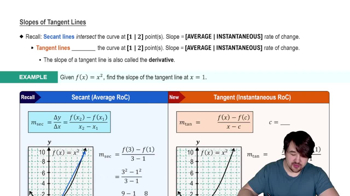
Slopes of Tangent Lines
6232
views
176
rank
1
comments
Guided course
05:10
Determine Continuity Algebraically Example 1
2417
views
105
rank
1
comments
Guided course
05:14
Equations of Tangent Lines
3350
views
103
rank
1
comments
Terms in this set (15)
Hide definitions
Secant Line
A straight path intersecting a curve at two distinct points, used to find average rate of change.
Tangent Line
A straight path touching a curve at exactly one point, representing instantaneous rate of change.
Slope
A measure of steepness for a line, calculated as the ratio of vertical to horizontal change.
Limit
A mathematical process describing the value a function approaches as the input nears a specific point.
Derivative
A value representing the instantaneous rate of change of a function at a specific input.
Point-Slope Form
An equation format for a line using a known point and the line's slope to express its relationship.
Difference of Squares
An algebraic expression of the form a^2 - b^2, which factors into (a + b)(a - b).
Indeterminate Form
An expression like 0/0, which lacks a defined value and requires algebraic manipulation to resolve.
Average Rate of Change
A value describing how a function changes between two points, found using a secant line.
Instantaneous Rate of Change
A value describing how a function changes at a single point, found using a tangent line or derivative.
Function
A rule assigning each input exactly one output, often written as f(x).
Factoring
A process of rewriting an expression as a product of simpler expressions, often to simplify limits.
Cancellation
A simplification step where common factors in the numerator and denominator are removed.
Numerator
The top part of a fraction, representing the quantity being divided.
Denominator
The bottom part of a fraction, indicating the number of equal parts the whole is divided into.
 BackBack
 05:13
05:13