Back

DNA libraries quiz

Control buttons has been changed to "navigation" mode.
1/15
  • What is a DNA library?

    A DNA library is a collection of DNA fragments that have been inserted into vectors for further study or manipulation.
  • What are the two main types of DNA libraries discussed?

    The two main types are genomic libraries and cDNA libraries.
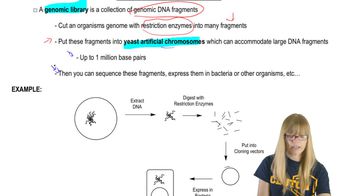
  • How is a genomic library constructed?

    A genomic library is made by isolating an organism's entire genomic DNA, fragmenting it with restriction enzymes, and inserting the fragments into vectors.
  • What is the role of restriction enzymes in creating a genomic library?

    Restriction enzymes cut the genomic DNA into fragments that can be inserted into vectors.
  • What is a vector in the context of DNA libraries?

    A vector is a DNA molecule, often circular, used to carry DNA fragments into bacteria or other organisms.
  • What is a yeast artificial chromosome and why is it used?

    A yeast artificial chromosome is a type of vector that can accommodate very large DNA fragments, up to 1,000,000 base pairs, making it useful for genomic libraries.
  • What can be done with DNA fragments once they are inserted into vectors?

    They can be sequenced or expressed in bacteria or other organisms for gene analysis.
  • What is the starting material for a cDNA library?

    A cDNA library starts with mRNA isolated from an organism.
  • How is cDNA generated from mRNA?

    cDNA is generated by reverse transcribing mRNA into DNA.
  • Why does cDNA lack introns?

    Because cDNA is made from mature mRNA, which has already had its introns spliced out, leaving only exons.
  • What does a cDNA library represent?

    A cDNA library represents the genes that are actively being expressed in a cell at a given time.
  • How can cDNA libraries be used to study gene expression?

    By comparing cDNA libraries made from cells under different conditions or at different times, researchers can see which genes are expressed in response to various stimuli.
  • Why are vectors important in the creation of DNA libraries?

    Vectors allow DNA fragments to be easily inserted into bacteria or other organisms for sequencing or expression studies.
  • What is the main difference between genomic and cDNA libraries?

    Genomic libraries contain all DNA fragments from the genome, while cDNA libraries contain only DNA copies of expressed mRNA (exons only).
  • How can DNA libraries help in identifying gene function?

    By expressing DNA fragments in bacteria and analyzing the resulting proteins or sequences, researchers can identify and study gene functions.