Skip to main content
Cell Biology
My Course
Learn
Exam Prep
AI Tutor
Study Guides
Flashcards
Explore
Try the app
My Course
Learn
Exam Prep
AI Tutor
Study Guides
Flashcards
Explore
Try the app
Back
Gluconeogenesis definitions
You can tap to flip the card.
Gluconeogenesis
You can tap to flip the card.
👆
Gluconeogenesis
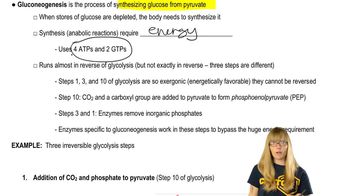
Metabolic pathway synthesizing glucose from pyruvate, activated when glucose stores are low and requiring significant energy input.
Track progress
Control buttons has been changed to "navigation" mode.
1/15
Related flashcards
Related practice
Recommended videos
Gluconeogenesis quiz
Gluconeogenesis
15 Terms
Gluconeogenesis
10. Anaerobic Respiration
7 problems
Topic
Fermentation
10. Anaerobic Respiration
7 problems
Topic
10. Anerobic Respiration
4 topics
12 problems
Chapter
Guided course
03:14
Feedback Regulation
472
views
7
rank
Guided course
04:09
Gluconeogenesis
596
views
6
rank
Guided course
03:04
Energy Storage in Other Macromolecules
447
views
5
rank
Terms in this set (15)
Hide definitions
Gluconeogenesis
Metabolic pathway synthesizing glucose from pyruvate, activated when glucose stores are low and requiring significant energy input.
Pyruvate
Three-carbon molecule produced at the end of glycolysis, serving as the starting point for glucose synthesis in gluconeogenesis.
ATP
High-energy nucleotide consumed during glucose synthesis and acting as a regulator of metabolic enzymes based on its cellular concentration.
GTP
Energy-carrying molecule used alongside ATP in the initial steps of glucose synthesis from pyruvate.
Glycolysis
Ten-step metabolic pathway breaking down glucose into pyruvate, with three steps that are highly exergonic and not reversible.
Phosphofructokinase
Key regulatory enzyme in glycolysis, activated by low ATP and inhibited by high ATP or fructose 2,6-bisphosphate.
Fructose 2,6-bisphosphate
Molecule that activates glycolysis by stimulating phosphofructokinase and inhibits glucose synthesis by blocking FBPase.
FBPase
Enzyme crucial for gluconeogenesis, inhibited by fructose 2,6-bisphosphate to prevent glucose synthesis when not needed.
Allosteric Regulation
Control mechanism where molecules bind to sites other than the active site, altering enzyme activity in metabolic pathways.
Acetyl CoA
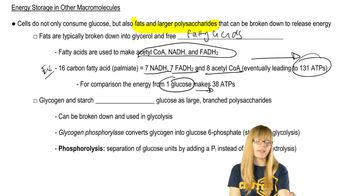
Two-carbon molecule generated from fatty acid breakdown, feeding into energy-producing cycles and ATP generation.
NADH
Electron carrier produced during fatty acid and glucose breakdown, later used to generate ATP in cellular respiration.
FADH2
Reduced electron carrier formed during fatty acid oxidation, contributing to ATP synthesis in mitochondria.
Glycogen
Branched polysaccharide storing glucose units, rapidly converted to glucose 6-phosphate for energy production.
Phosphorolysis
Process of breaking chemical bonds using inorganic phosphate instead of water, as seen in glycogen breakdown.
Glucose 6-phosphate
Phosphorylated glucose derivative formed directly from glycogen or as the first product in glycolysis.
 BackBack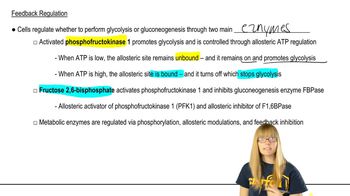
 03:14
03:14