What is gluconeogenesis and when does the body use it?
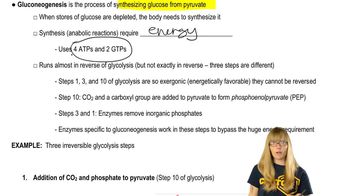
Gluconeogenesis is the metabolic pathway that synthesizes glucose from pyruvate, and it is used when glucose stores are depleted.
How much energy does gluconeogenesis require to produce one glucose molecule?
Gluconeogenesis requires 4 ATP and 2 GTP molecules to synthesize one glucose molecule.
Why can't gluconeogenesis simply reverse all the steps of glycolysis?
Three steps in glycolysis are too exergonic to be reversed, so gluconeogenesis uses different enzymes to bypass these steps.
Which steps in glycolysis are bypassed by gluconeogenesis, and why?
Steps 1, 3, and 10 of glycolysis are bypassed because their reactions release too much energy to be reversed.
What happens in the first step of gluconeogenesis?
CO2 and phosphate are added to pyruvate, using ATP and GTP, to form a new molecule.
How does the regulation of phosphofructokinase affect glycolysis?
Phosphofructokinase is activated when ATP is low, promoting glycolysis, and inhibited when ATP is high, stopping glycolysis.
What role does fructose 2,6-bisphosphate play in metabolic regulation?
Fructose 2,6-bisphosphate activates phosphofructokinase 1 to promote glycolysis and inhibits FBPase to suppress gluconeogenesis.
How does allosteric regulation affect phosphofructokinase activity?
High ATP binds to both the active and allosteric sites of phosphofructokinase, inactivating it and stopping glycolysis.
What is phosphorolysis and how does it differ from hydrolysis?
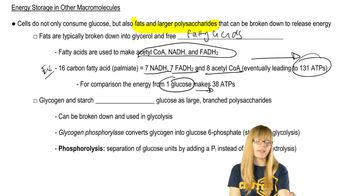
Phosphorolysis breaks apart molecules using inorganic phosphate instead of water, unlike hydrolysis.
How are fats broken down for energy in the cell?
Fats are broken down into glycerol and free fatty acids, which can be converted into Acetyl CoA, NADH, and FADH2 for energy production.
How does the energy yield from fatty acid breakdown compare to glucose?
Fatty acid breakdown yields much more ATP than glucose; for example, a 16-carbon fatty acid can produce about 131 ATP, while one glucose yields about 38 ATP.
How is glycogen converted for use in glycolysis?
Glycogen is broken down by glycogen phosphorylase into glucose 6-phosphate, which can directly enter glycolysis.
What is the significance of glucose 6-phosphate in metabolism?
Glucose 6-phosphate is an intermediate in glycolysis and can be produced directly from glycogen breakdown.
What are the main ways cells decide between glycolysis and gluconeogenesis?
Cells use the regulation of key enzymes like phosphofructokinase and FBPase, influenced by ATP and fructose 2,6-bisphosphate levels, to decide between glycolysis and gluconeogenesis.
What is the role of FBPase in gluconeogenesis?
FBPase is an enzyme essential for gluconeogenesis, and its activity is inhibited by fructose 2,6-bisphosphate.
 Back
Back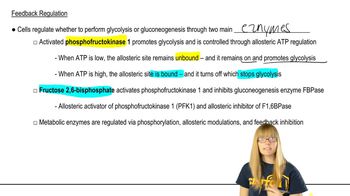
 03:14
03:14