Skip to main content
Cell Biology
My Course
Learn
Exam Prep
AI Tutor
Study Guides
Flashcards
Explore
Try the app
My Course
Learn
Exam Prep
AI Tutor
Study Guides
Flashcards
Explore
Try the app
Back
Glycolysis definitions
You can tap to flip the card.
Glycolysis
You can tap to flip the card.
👆
Glycolysis
A cytosolic pathway converting glucose to pyruvate, yielding ATP and NADH, and functioning without oxygen.
Track progress
Control buttons has been changed to "navigation" mode.
1/14
Related flashcards
Related practice
Recommended videos
Glycolysis quiz #1
Glycolysis
38 Terms
Glycolysis
10. Anaerobic Respiration
7 problems
Topic
Fermentation
10. Anaerobic Respiration
7 problems
Topic
10. Anerobic Respiration
4 topics
12 problems
Chapter
Guided course
11:10
Glycolysis Steps
906
views
9
rank
4
comments
Guided course
03:51
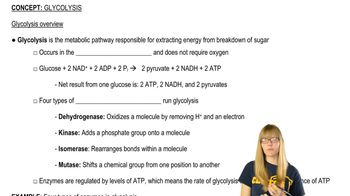
Glycolysis Overview
1249
views
17
rank
1
comments
Terms in this set (14)
Hide definitions
Glycolysis
A cytosolic pathway converting glucose to pyruvate, yielding ATP and NADH, and functioning without oxygen.
Glucose
A six-carbon sugar serving as the initial substrate for energy extraction in cellular metabolic pathways.
Pyruvate
A three-carbon end product of glycolysis, acting as a key intermediate for further metabolic processing.
ATP
A universal energy currency produced and consumed during glycolysis, with a net gain of two per glucose.
NADH
An electron carrier generated during glycolysis, crucial for transferring high-energy electrons to later pathways.
Cytosol
The cellular compartment where glycolysis occurs, allowing glucose breakdown independently of organelles.
Dehydrogenase
An enzyme type that oxidizes substrates by removing protons and electrons, facilitating NADH formation.
Kinase
An enzyme that catalyzes the transfer of phosphate groups, essential for phosphorylation steps in glycolysis.
Isomerase
An enzyme that rearranges bonds within molecules, enabling structural changes during glycolytic steps.
Mutase
An enzyme shifting chemical groups within a molecule, altering positions without adding or removing atoms.
Phosphorylation
A process involving the addition of phosphate groups to molecules, crucial for trapping glucose in cells.
Phosphofructokinase
A regulatory enzyme catalyzing a key phosphorylation step, controlling glycolytic flux based on ATP levels.
Glyceraldehyde-3-phosphate
A three-carbon intermediate formed after glucose cleavage, central to energy extraction in glycolysis.
Substrate-level phosphorylation
A mechanism of ATP synthesis where a phosphate group is directly transferred from a substrate to ADP.
 BackBack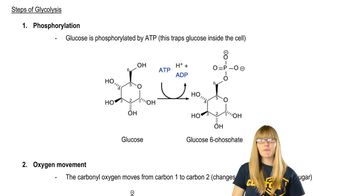
 11:10
11:10