Skip to main content
Cell Biology
My Course
Learn
Exam Prep
AI Tutor
Study Guides
Flashcards
Explore
Try the app
My Course
Learn
Exam Prep
AI Tutor
Study Guides
Flashcards
Explore
Try the app
Back
Membrane Proteins definitions
You can tap to flip the card.
Transmembrane Protein
You can tap to flip the card.
👆
Transmembrane Protein
Spans the entire lipid bilayer, often forming alpha helices or beta barrels, and can function asymmetrically on each side of the membrane.
Track progress
Control buttons has been changed to "navigation" mode.
1/15
Related flashcards
Related practice
Recommended videos
Membrane Proteins quiz #1
Membrane Proteins
13 Terms
Membrane Proteins
8. Membrane Structure
7 problems
Topic
The Lipid Bilayer
8. Membrane Structure
7 problems
Topic
8. Membrane Structure
2 topics
6 problems
Chapter
Guided course
02:24
Alpha Helices and Beta Barrels
758
views
14
rank
Guided course
04:23
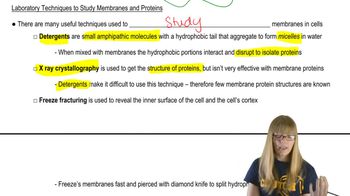
Laboratory Techniques
654
views
5
rank
Guided course
06:20
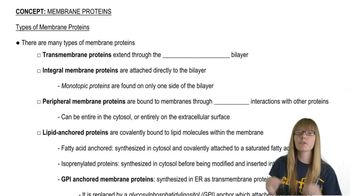
Types of Membrane Proteins
1106
views
13
rank
Terms in this set (15)
Hide definitions
Transmembrane Protein
Spans the entire lipid bilayer, often forming alpha helices or beta barrels, and can function asymmetrically on each side of the membrane.
Integral Membrane Protein
Directly attached to the lipid bilayer, may extend through or associate with only one side, and interacts with membrane lipids.
Peripheral Membrane Protein
Associates with the membrane via interactions with other proteins, not directly with lipids, and is confined to one side of the bilayer.
Lipid-Anchored Protein
Covalently bound to membrane lipids, providing strong attachment; includes types like GPI-anchored and fatty acid-anchored proteins.
Alpha Helix
Common structure in membrane-spanning regions, with hydrophobic side chains interacting with lipid tails, masking hydrophilic portions.
Beta Barrel
Cylindrical structure formed by beta sheets, often creating channels for large molecules to cross the membrane.
Glycoprotein
Protein with attached carbohydrate chains, contributing to cell protection and extracellular interactions.
Glycolipid
Lipid molecule with a carbohydrate group, found on the membrane surface, involved in cell recognition.
Glycocalyx
Protective, carbohydrate-rich layer on the cell surface, formed by glycoproteins and glycolipids.
Cell Cortex
Network beneath the plasma membrane, composed of proteins and cytoskeleton, supporting cell shape and limiting protein movement.
Lateral Diffusion
Movement of membrane proteins or lipids within the same layer of the bilayer, contributing to membrane fluidity.
Rotational Diffusion
Spinning of membrane proteins or lipids around their axis within the bilayer, affecting membrane dynamics.
Freeze Fracturing
Technique that splits frozen membranes to reveal embedded proteins and inner membrane surfaces for structural study.
FRAP
Method using fluorescence recovery to measure mobility and fluidity of membrane proteins or lipids after photobleaching.
Detergent
Small molecule with hydrophobic and hydrophilic regions, used to disrupt membranes and isolate proteins in laboratory studies.
 BackBack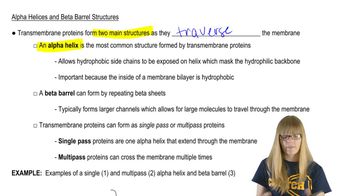
 02:24
02:24