Skip to main content
Cell Biology
My Course
Learn
Exam Prep
AI Tutor
Study Guides
Flashcards
Explore
Try the app
My Course
Learn
Exam Prep
AI Tutor
Study Guides
Flashcards
Explore
Try the app
Back
MHC and Antigen Presentation definitions
You can tap to flip the card.
Major Histocompatibility Complex
You can tap to flip the card.
👆
Major Histocompatibility Complex
A group of molecules crucial for presenting antigen fragments to T cells, enabling immune system activation and pathogen recognition.
Track progress
Control buttons has been changed to "navigation" mode.
1/15
Related flashcards
Related practice
Recommended videos
MHC and Antigen Presentation quiz #1
MHC and Antigen Presentation
10 Terms
MHC and Antigen Presentation
21. The Immune System
7 problems
Topic
Immune System Collaboration
21. The Immune System
7 problems
Topic
21. The Immune System - Part 1 of 2
4 topics
11 problems
Chapter
21. The Immune System - Part 2 of 2
4 topics
10 problems
Chapter
Guided course
03:00
Class I MHC
273
views
2
rank
Guided course
02:34
Class II MHC
267
views
2
rank
Terms in this set (15)
Hide definitions
Major Histocompatibility Complex
A group of molecules crucial for presenting antigen fragments to T cells, enabling immune system activation and pathogen recognition.
MHC Class 1
A molecule with a single polypeptide chain and Beta 2 microglobulin, presenting intracellular peptides to cytotoxic T cells.
MHC Class 2
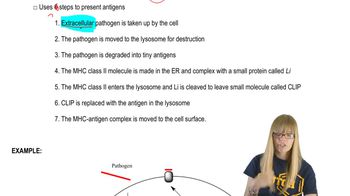
A heterodimeric molecule encoded by two genes, presenting extracellular peptides to T helper and regulatory T cells.
Cytotoxic T Cell
A lymphocyte activated by peptide-MHC class 1 complexes, specialized in targeting and destroying infected cells.
T Helper Cell
A lymphocyte activated by peptide-MHC class 2 complexes, essential for coordinating immune responses.
T Regulatory Cell
A lymphocyte activated by peptide-MHC class 2 complexes, involved in suppressing immune reactions to maintain tolerance.
Beta 2 Microglobulin
A small protein non-covalently associated with MHC class 1, stabilizing its structure for antigen presentation.
Peptide Binding Site
A groove on MHC molecules where antigen fragments are loaded for display to T cells, differing in length between classes.
Ubiquitin-Proteasome Pathway
A cellular system that tags and degrades intracellular proteins into peptides for MHC class 1 presentation.
Endoplasmic Reticulum
An organelle where MHC molecules are assembled and loaded with antigenic peptides before surface expression.
Lysosome
A vesicular compartment where extracellular pathogens are degraded into peptides for MHC class 2 loading.
CLIP
A peptide fragment occupying the MHC class 2 binding site in the lysosome, temporarily blocking premature peptide loading.
Heterodimer
A protein complex formed by two different polypeptide chains, characteristic of MHC class 2 structure.
Antigen
A molecular fragment, often from a pathogen, recognized and presented by MHC molecules to activate T cells.
Pathogen
An infectious agent, either intracellular or extracellular, whose fragments are processed for immune recognition.
 BackBack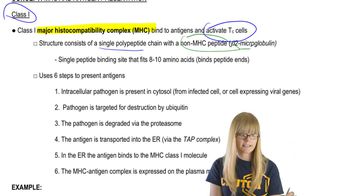
 03:00
03:00