What is the primary function of mitochondria in eukaryotic cells?
The primary function of mitochondria is to produce ATP through oxidative phosphorylation, serving as the powerhouse of the cell.
Describe the structure and function of the outer mitochondrial membrane.
The outer mitochondrial membrane contains porin proteins that form channels, allowing certain molecules and ions to enter the mitochondria.
What is the significance of the inner mitochondrial membrane's impermeability to ions and small molecules?
The inner mitochondrial membrane's impermeability is crucial for maintaining the proton gradient needed for ATP production during oxidative phosphorylation.
What are cristae, and why are they important in mitochondria?
Cristae are folds in the inner mitochondrial membrane that increase surface area, allowing for more electron transport chain proteins and ATP synthase, thus enhancing ATP production.
Where is the mitochondrial matrix located, and what are its main components?
The mitochondrial matrix is inside the inner membrane and contains mitochondrial DNA, ribosomes, enzymes, and is the site of the citric acid cycle.
How do mitochondria move within the cell, and what is the purpose of this movement?
Mitochondria move along microtubules within the cell to position themselves where energy demand is highest.
Explain the process and significance of mitochondrial fusion.
Mitochondrial fusion involves mitochondria joining together to form tubular networks, allowing them to exchange resources and increase efficiency in ATP production.
What evidence supports the endosymbiotic origin of mitochondria?
Mitochondria have their own circular DNA and ribosomes, similar to prokaryotes, supporting the theory that they originated from engulfed prokaryotic cells.
Why are mitochondria not completely self-sufficient despite having their own DNA and ribosomes?
Mitochondria are not fully self-sufficient because they lack all the genes needed for their proteins and must import some proteins encoded by nuclear DNA.
What is the role of cytochrome c in the mitochondria?
Cytochrome c is located in the intermembrane space and plays a key role in the electron transport chain by transferring electrons.
Where does the citric acid cycle occur within the mitochondria, and why is this location important?
The citric acid cycle occurs in the mitochondrial matrix, which contains the necessary enzymes and substrates for the cycle.
How do large proteins synthesized in the cytosol enter the mitochondria?
Large proteins made in the cytosol require special targeting signals and transport mechanisms to cross the outer and inner mitochondrial membranes.
Which types of cells typically have more mitochondria than others?
Cells with high energy demands, such as muscle cells, typically have more mitochondria than cells with lower energy requirements.
What is the main function of mitochondria in cells?
The main function of mitochondria is to produce ATP through oxidative phosphorylation, providing energy for cellular processes.
Are mitochondria found in both plant and animal cells?
Yes, mitochondria are present in both plant and animal cells.
Why are mitochondria referred to as the powerhouse of the cell?
Mitochondria are called the powerhouse of the cell because they generate most of the cell's ATP, which is the primary energy currency.
What process occurs in the mitochondria to produce energy?
Cellular respiration, specifically oxidative phosphorylation, occurs in the mitochondria to produce ATP.
Which organelle is responsible for energy production in the cell?
The mitochondrion is responsible for energy production in the cell.
Why do muscle cells have more mitochondria than skin cells?
Muscle cells have more mitochondria because they require more energy for contraction and movement.
What is the role of the mitochondrial matrix?
The mitochondrial matrix contains mitochondrial DNA, ribosomes, enzymes, and is the site of the citric acid cycle.
What is the function of the cristae in mitochondria?
Cristae are folds in the inner mitochondrial membrane that increase surface area for electron transport chain proteins and ATP synthase, enhancing ATP production.
Which organelle contains its own DNA and ribosomes?
Mitochondria contain their own DNA and ribosomes.
What is the significance of mitochondria having their own DNA?
Mitochondria having their own DNA supports the endosymbiotic theory and allows them to produce some of their own proteins.
What is the main site of ATP production in the cell?
The main site of ATP production in the cell is the mitochondrion.
What is the function of ATP synthase in mitochondria?
ATP synthase is an enzyme in the inner mitochondrial membrane that synthesizes ATP from ADP and inorganic phosphate during oxidative phosphorylation.
What is the function of the outer mitochondrial membrane?
The outer mitochondrial membrane contains porin proteins that allow certain molecules to enter the mitochondria.
What is the function of the inner mitochondrial membrane?
The inner mitochondrial membrane is the site of the electron transport chain and ATP synthesis, and is impermeable to ions and small molecules without specialized proteins.
What is the intermembrane space in mitochondria?
The intermembrane space is the region between the outer and inner mitochondrial membranes, chemically similar to the cytosol and containing few proteins.
What is cytochrome c and where is it found?
Cytochrome c is a protein involved in the electron transport chain, found in the intermembrane space of mitochondria.
What is the endosymbiotic theory regarding mitochondria?
The endosymbiotic theory suggests that mitochondria originated from prokaryotes that were engulfed by ancestral eukaryotic cells.
How do mitochondria move within the cell?
Mitochondria move within the cell along microtubules.
Why do some cells have more mitochondria than others?
Cells with higher energy requirements have more mitochondria to meet their ATP needs.
What is the shape of mitochondria?
Mitochondria are typically bean-shaped or rice grain-shaped.
What is the function of the mitochondrial DNA?
Mitochondrial DNA encodes some of the proteins, tRNAs, and rRNAs needed for mitochondrial function.
What is the function of the mitochondrial ribosomes?
Mitochondrial ribosomes synthesize proteins encoded by mitochondrial DNA.
What is the main function of the citric acid cycle in mitochondria?
The citric acid cycle in the mitochondrial matrix generates electron carriers for the electron transport chain.
What is the function of porin proteins in mitochondria?
Porin proteins in the outer mitochondrial membrane form channels that allow certain molecules to enter the mitochondria.
What is the significance of the impermeability of the inner mitochondrial membrane?
The impermeability of the inner mitochondrial membrane is crucial for maintaining the proton gradient needed for ATP synthesis.
What is the function of the electron transport chain in mitochondria?
The electron transport chain transfers electrons and pumps protons to create a gradient used by ATP synthase to produce ATP.
What is the main energy currency produced by mitochondria?
The main energy currency produced by mitochondria is ATP (adenosine triphosphate).
 Back
Back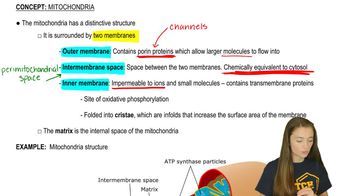
 10:27
10:27