Skip to main content
Cell Biology
My Course
Learn
Exam Prep
AI Tutor
Study Guides
Flashcards
Explore
Try the app
My Course
Learn
Exam Prep
AI Tutor
Study Guides
Flashcards
Explore
Try the app
Back
Mitosis definitions
You can tap to flip the card.
Mitosis
You can tap to flip the card.
👆
Mitosis
A process of cellular division producing two genetically identical daughter cells through a series of regulated steps.
Track progress
Control buttons has been changed to "navigation" mode.
1/15
Related flashcards
Related practice
Recommended videos
Mitosis quiz #1
Mitosis
40 Terms
Mitosis quiz #2
Mitosis
40 Terms
Mitosis quiz #3
Mitosis
40 Terms
Mitosis
16. Cell Division
7 problems
Topic
Cytokinesis
16. Cell Division
7 problems
Topic
16. Cell Division - Part 1 of 2
5 topics
14 problems
Chapter
16. Cell Division - Part 2 of 2
5 topics
13 problems
Chapter
Guided course
07:03
Mitosis Steps
613
views
4
rank
1
comments
Guided course
08:29
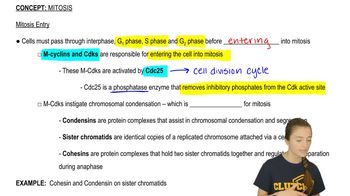
Mitosis Entry
755
views
16
rank
Terms in this set (15)
Hide definitions
Mitosis
A process of cellular division producing two genetically identical daughter cells through a series of regulated steps.
Cell Cycle
A sequence of phases including G1, S, G2, and M, guiding cell growth, DNA replication, and division.
G1 Phase
The initial growth period where a cell increases in size, accumulates nutrients, and prepares for DNA synthesis.
S Phase
A stage dedicated to DNA replication, ensuring each daughter cell receives a complete genetic copy.
G2 Phase
A preparatory interval following DNA synthesis, allowing the cell to finalize readiness for mitosis.
M Cyclins
Regulatory proteins whose concentration rises before and during mitosis, activating kinases for cell division.
Cyclin-Dependent Kinases
Enzymes activated by cyclins, responsible for phosphorylating proteins that drive cell cycle progression.
CDC25
A phosphatase protein that removes inhibitory phosphates from kinases, enabling entry into mitosis.
Condensins
Protein complexes that compact chromatin into highly condensed chromosomes, facilitating their movement.
Cohesins
Protein complexes maintaining the connection between sister chromatids until their separation in anaphase.
Sister Chromatids
Identical DNA copies formed during replication, joined together and destined for segregation during mitosis.
Centromere
A specialized DNA region linking sister chromatids and serving as the attachment site for spindle fibers.
Mitotic Spindle
A microtubule-based structure organizing and segregating chromosomes during mitosis.
Spindle Assembly Checkpoint
A control mechanism ensuring chromosomes are properly aligned before chromatid separation.
Anaphase Promoting Complex
A protein complex triggering chromatid separation and progression toward mitotic exit by degrading specific proteins.
 BackBack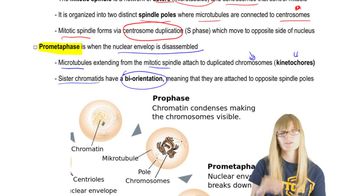
 07:03
07:03