Skip to main content
Cell Biology
My Course
Learn
Exam Prep
AI Tutor
Study Guides
Flashcards
Explore
Try the app
My Course
Learn
Exam Prep
AI Tutor
Study Guides
Flashcards
Explore
Try the app
Back
Protein Degradation definitions
You can tap to flip the card.
Proteasome
You can tap to flip the card.
👆
Proteasome
Multi-subunit cylindrical complex that unfolds and degrades ubiquitin-tagged proteins into short peptides using ATP.
Track progress
Control buttons has been changed to "navigation" mode.
1/15
Related flashcards
Related practice
Recommended videos
Protein Degradation quiz
Protein Degradation
15 Terms
Protein Degradation
6. Proteins
7 problems
Topic
Protein Regulation
6. Proteins
7 problems
Topic
6. Proteins - Part 1 of 2
3 topics
9 problems
Chapter
6. Proteins - Part 2 of 2
3 topics
9 problems
Chapter
Guided course
04:09
Ubiquitin Proteasome Pathway
470
views
2
rank
2
comments
Guided course
01:44
Lysosomal Pathway
351
views
Guided course
02:31
Degradation Regulation
305
views
Terms in this set (15)
Hide definitions
Proteasome
Multi-subunit cylindrical complex that unfolds and degrades ubiquitin-tagged proteins into short peptides using ATP.
Ubiquitin
Small, 76-amino acid protein found in all eukaryotes, used to tag proteins for selective degradation.
E1 Enzyme
Catalyst responsible for activating ubiquitin in the initial step of the ubiquitin-proteasome pathway.
E2 Enzyme
Conjugating enzyme that binds activated ubiquitin and collaborates with E3 ligase for protein tagging.
E3 Ligase
Protein responsible for recognizing specific substrates and attaching ubiquitin to target proteins.
Polyubiquitination
Attachment of multiple ubiquitin molecules to a protein, signaling it for proteasomal degradation.
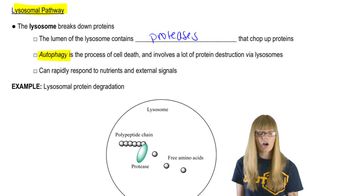
Lysosome
Membrane-bound organelle containing proteases that degrade proteins and other cellular components.
Protease
Enzyme that catalyzes the breakdown of proteins into amino acids or peptides within degradation pathways.
Autophagy
Cellular process involving lysosomal degradation of cytoplasmic components, especially during stress or starvation.
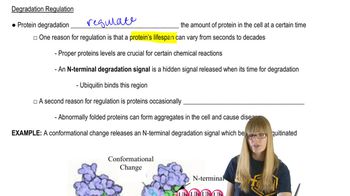
Degradation Signal
Hidden or exposed sequence within a protein that marks it for destruction when revealed.
Peptide
Short chain of amino acids produced as an intermediate during protein breakdown.
Protein Aggregation
Accumulation of misfolded proteins in the cell, potentially leading to dysfunction or disease.
Homeostasis
Cellular state maintained by regulated protein levels through controlled degradation mechanisms.
Misfolded Protein
Abnormally structured polypeptide that can disrupt cellular function if not efficiently degraded.
Amino Acid
Basic building block released from proteins during lysosomal or proteasomal degradation.
 BackBack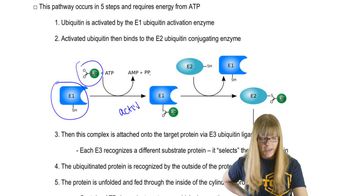
 04:09
04:09