What is the main function of the proteasome in protein degradation?
The proteasome is a multi-subunit protein complex that degrades proteins tagged with ubiquitin into short peptides.
What is ubiquitin and what role does it play in protein degradation?
Ubiquitin is a small, 76-amino acid protein found in all eukaryotes that tags proteins for degradation by the proteasome.
What are the five main steps of the ubiquitin-proteasome pathway?
The steps are: ubiquitin activation by E1, conjugation to E2, transfer to the target protein by E3 ligase, recognition by the proteasome, and degradation within the proteasome.
Which enzyme is responsible for activating ubiquitin in the first step of the pathway?
The E1 ubiquitin-activating enzyme is responsible for activating ubiquitin.
What is the role of the E3 ubiquitin ligase in the ubiquitin-proteasome pathway?
E3 ligase attaches ubiquitin to the target protein and is responsible for substrate specificity, recognizing which proteins should be degraded.
How does the proteasome degrade proteins after they are tagged with ubiquitin?
The proteasome unfolds the ubiquitinated protein and feeds it through a cylindrical channel, where it is chopped into short peptides by ATP-dependent proteases.
What is the main difference between the lysosomal and proteasomal pathways of protein degradation?
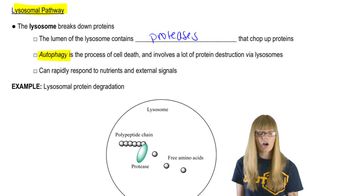
The lysosomal pathway does not require ubiquitin tagging; proteins are directly transported into the lysosome and degraded by proteases.
What is autophagy and how is it related to protein degradation?
Autophagy is a process where cellular components, including proteins, are broken down in the lysosome, especially during cell stress or nutrient scarcity.
Why is protein degradation important for cellular regulation?
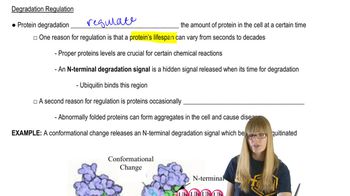
Protein degradation controls protein levels in the cell, influencing cellular functions and maintaining homeostasis.
What can happen if misfolded proteins are not properly degraded?
Misfolded proteins can aggregate in the cell and cause diseases or cellular dysfunction.
How does the cell recognize when a protein has reached the end of its lifespan?
Proteins often have internal degradation signals that are exposed by conformational changes, triggering their degradation.
What energy source is required for the ubiquitin-proteasome pathway?
ATP is required for both ubiquitin activation and the proteasome's protein-degrading activity.
How does the lysosomal pathway respond to changes in nutrient levels?
The lysosomal pathway can rapidly degrade proteins in response to nutrient scarcity or external signals.
What is the fate of proteins degraded in the lysosome?
Proteins are broken down into free amino acids by proteases within the lysosome.
Why are there many different E3 ligases in the cell?
Each E3 ligase recognizes and targets different substrate proteins for ubiquitination, providing specificity to the degradation process.
 Back
Back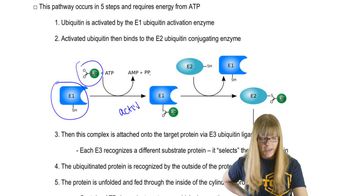
 04:09
04:09