Skip to main content
Cell Biology
My Course
Learn
Exam Prep
AI Tutor
Study Guides
Flashcards
Explore
Try the app
My Course
Learn
Exam Prep
AI Tutor
Study Guides
Flashcards
Explore
Try the app
Back
Protein Regulation definitions
You can tap to flip the card.
Phosphorylation
You can tap to flip the card.
👆
Phosphorylation
Reversible addition of phosphate groups, introducing negative charges that cause conformational changes and alter protein activity.
Track progress
Control buttons has been changed to "navigation" mode.
1/15
Related flashcards
Related practice
Recommended videos
Protein Regulation quiz
Protein Regulation
15 Terms
Protein Regulation
6. Proteins
7 problems
Topic
Protein Degradation
6. Proteins
7 problems
Topic
6. Proteins - Part 1 of 2
3 topics
9 problems
Chapter
6. Proteins - Part 2 of 2
3 topics
9 problems
Chapter
Guided course
02:46
GTP and Calcium Binding
342
views
Guided course
01:47
Protein Machines
292
views
Guided course
04:17
Covalent Modifications
507
views
1
rank
Terms in this set (15)
Hide definitions
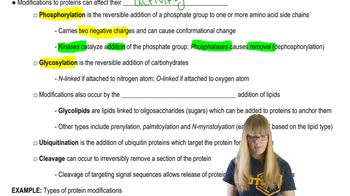
Phosphorylation
Reversible addition of phosphate groups, introducing negative charges that cause conformational changes and alter protein activity.
Glycosylation
Reversible attachment of carbohydrates, such as oligosaccharides, to proteins, influencing their function and localization.
Ubiquitination
Attachment of a small protein marker that targets proteins for degradation, controlling protein lifespan in the cell.
Cleavage
Irreversible cutting of a protein segment, often altering its function, localization, or activation state.
GTP Binding
Association of guanosine triphosphate with proteins, enabling activation or inactivation through conformational changes.
GTP Hydrolysis
Conversion of GTP to GDP, typically resulting in protein inactivation and regulation of signaling pathways.
Calcium Binding
Interaction with calcium ions, allowing proteins to respond to changes in cellular calcium concentration.
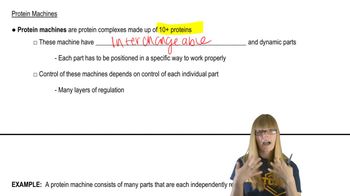
Protein Machine
Complex of ten or more proteins with dynamic, interchangeable parts, requiring precise regulation for coordinated function.
Kinase
Enzyme responsible for adding phosphate groups to proteins, modulating their activity.
Phosphatase
Enzyme that removes phosphate groups from proteins, reversing phosphorylation effects.
O-Linked Glycosylation
Attachment of carbohydrates to the oxygen atom of serine or threonine residues in proteins.
N-Linked Glycosylation
Attachment of carbohydrates to the nitrogen atom of asparagine residues in proteins.
Lipid Modification
Covalent addition of lipid groups to proteins, often anchoring them to membranes or altering their interactions.
Conformational Change
Structural alteration in a protein, often triggered by modifications, that impacts its activity or interactions.
Degradation
Process by which proteins are broken down, often following specific modifications that mark them for removal.
 BackBack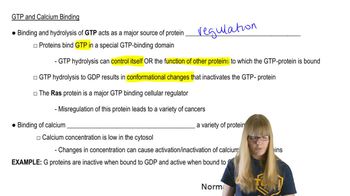
 02:46
02:46