What is phosphorylation and how does it affect proteins?
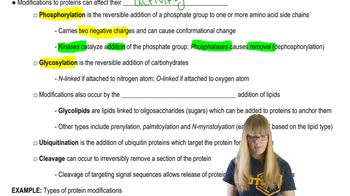
Phosphorylation is the reversible addition of a phosphate group to a protein, which can cause conformational changes and affect the protein's activity.
Which enzymes are responsible for adding and removing phosphate groups during phosphorylation?
Kinases add phosphate groups to proteins, while phosphatases remove them.
What is glycosylation and what are its two main types?
Glycosylation is the reversible addition of carbohydrates to proteins, with N-linked glycosylation attaching to nitrogen and O-linked glycosylation attaching to oxygen.
How does the covalent addition of lipids affect proteins?
The covalent addition of lipids can anchor proteins to membranes and influence their function and localization.
What is ubiquitination and what is its main function?
Ubiquitination is the attachment of ubiquitin to a protein, marking it for degradation.
What is cleavage in the context of protein regulation, and is it reversible?
Cleavage is the cutting of a section of a protein, and it is generally an irreversible modification.
How does GTP binding regulate protein activity?
Proteins can bind GTP and hydrolyze it to GDP, causing conformational changes that activate or inactivate themselves or other proteins.
Why is the GTP-GDP transition important in protein regulation?
The GTP-GDP transition is crucial because it controls the activation state of proteins, such as the Ras protein, which is important in processes like cancer development.
How does calcium binding regulate proteins?
Changes in cellular calcium concentration can activate or inactivate proteins that bind calcium, affecting various cellular processes.
What are protein machines and how many proteins do they typically contain?
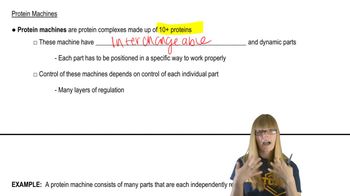
Protein machines are complexes of 10 or more proteins that work together dynamically to perform specific cellular functions.
Why is precise regulation of each component important in protein machines?
Each protein in a machine must be correctly regulated and positioned for the machine to function properly; missing or misregulated parts can disrupt the entire complex.
What is the main difference between reversible and irreversible protein modifications?
Reversible modifications, like phosphorylation and glycosylation, can be added or removed, while irreversible modifications, like cleavage, permanently alter the protein.
What is the role of kinases and phosphatases in protein regulation?
Kinases add phosphate groups to proteins, activating or deactivating them, while phosphatases remove these groups to reverse the effect.
How can the addition of sugars or lipids to proteins influence their function?
Adding sugars or lipids can change a protein's location, stability, or interactions with other molecules, thus regulating its activity.
What happens if a protein component is missing from a protein machine?
If a protein is missing, the protein machine cannot function properly because all components must be present and regulated for correct operation.
 Back
Back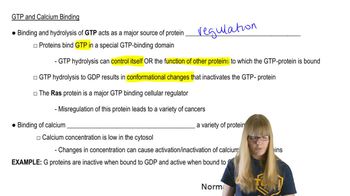
 02:46
02:46