Skip to main content
Cell Biology
My Course
Learn
Exam Prep
AI Tutor
Study Guides
Flashcards
Explore
Try the app
My Course
Learn
Exam Prep
AI Tutor
Study Guides
Flashcards
Explore
Try the app
Back
Structure and Function of DNA definitions
You can tap to flip the card.
Nucleotide
You can tap to flip the card.
👆
Nucleotide
Building block containing a sugar, phosphate group, and one of four nitrogenous bases; forms the basic unit of genetic material.
Track progress
Control buttons has been changed to "navigation" mode.
1/15
Related flashcards
Related practice
Recommended videos
Structure and Function of DNA quiz #1
Structure and Function of DNA
10 Terms
Structure and Function of DNA
4. DNA, Chromosomes, and Genomes
7 problems
Topic
Helical Formations of DNA
4. DNA, Chromosomes, and Genomes
7 problems
Topic
4. DNA, Chromosomes, and Genomes - Part 1 of 2
5 topics
14 problems
Chapter
4. DNA, Chromosomes, and Genomes - Part 2 of 2
5 topics
13 problems
Chapter
Guided course
08:23
Nucleotides and DNA
869
views
11
rank
Terms in this set (15)
Hide definitions
Nucleotide
Building block containing a sugar, phosphate group, and one of four nitrogenous bases; forms the basic unit of genetic material.
Adenine
Purine base with two carbon rings; pairs with thymine via two hydrogen bonds in genetic material.
Cytosine
Pyrimidine base with one carbon ring; forms three hydrogen bonds with guanine in double-stranded genetic material.
Guanine
Purine base with two carbon rings; establishes three hydrogen bonds with cytosine in the double helix.
Thymine
Pyrimidine base with one carbon ring; connects to adenine through two hydrogen bonds in genetic strands.
Purine
Nitrogenous base category with two carbon rings; includes adenine and guanine.
Pyrimidine
Nitrogenous base category with a single carbon ring; includes cytosine and thymine.
Base Pair
Two nitrogenous bases joined by hydrogen bonds, forming the rungs of the double helix.
Hydrogen Bond
Weak interaction stabilizing base pairs; two connect adenine-thymine, three connect guanine-cytosine.
Sugar-Phosphate Backbone
Structural framework of genetic strands, formed by alternating sugars and phosphate groups.
Directionality
Orientation of a genetic strand, defined by 5' phosphate and 3' hydroxyl ends, crucial for strand pairing.
Double Helix
Energetically favorable structure with two antiparallel strands and complementary base pairing.
Antiparallel
Arrangement where two strands run in opposite directions, enabling proper base pairing.
Major Groove
Wider region in the double helix, providing access for protein interactions.
B-DNA
Most common right-handed double helix form, featuring 10 base pairs per helical turn.
 BackBack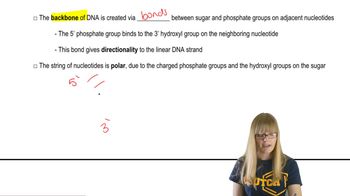
 08:23
08:23