Skip to main content
Cell Biology
My Course
Learn
Exam Prep
AI Tutor
Study Guides
Flashcards
Explore
Try the app
My Course
Learn
Exam Prep
AI Tutor
Study Guides
Flashcards
Explore
Try the app
Back
T Cells definitions
You can tap to flip the card.
T Cell
You can tap to flip the card.
👆
T Cell
A lymphocyte of the adaptive immune system, requiring activation by antigen presenting cells to target pathogens.
Track progress
Control buttons has been changed to "navigation" mode.
1/17
Related flashcards
Related practice
Recommended videos
T Cells quiz #1
T Cells
10 Terms
T Cells
21. The Immune System
7 problems
Topic
MHC and Antigen Presentation
21. The Immune System
7 problems
Topic
21. The Immune System - Part 1 of 2
4 topics
11 problems
Chapter
21. The Immune System - Part 2 of 2
4 topics
10 problems
Chapter
Guided course
08:07
T Cells
279
views
5
rank
Terms in this set (17)
Hide definitions
T Cell
A lymphocyte of the adaptive immune system, requiring activation by antigen presenting cells to target pathogens.
Adaptive Immune System
A defense system characterized by specificity and memory, involving cells that recognize and respond to diverse antigens.
Antigen Presenting Cell
A cell type, such as a dendritic cell, that processes and displays antigens to lymphocytes for immune activation.
Antigen
A molecular fragment from pathogens, processed and displayed by immune cells to trigger a specific lymphocyte response.
MHC Molecule
A cell surface complex that presents processed antigen fragments to lymphocytes, crucial for immune recognition.
T Cell Receptor
A highly variable surface protein enabling lymphocytes to recognize a vast array of antigen-MHC complexes.
VDJ Recombination
A genetic rearrangement process generating receptor diversity, allowing recognition of numerous antigens.
Cytotoxic T Cell
A lymphocyte subtype specialized in inducing death of infected or abnormal cells via mechanisms like perforin release.
Helper T Cell
A lymphocyte subtype that stimulates other immune cells, enhancing responses through activation and signaling molecules.
Regulatory T Cell
A lymphocyte subtype that suppresses immune responses, preventing overactivity and autoimmunity.
Co-stimulatory Molecule
A surface protein required for full lymphocyte activation, ensuring immune responses occur only under proper conditions.
Cell Adhesion Molecule
A protein facilitating stable contact between immune cells, essential for effective activation and signaling.
Perforin
A cytolytic protein released by certain lymphocytes, forming pores in target cell membranes to induce cell death.
FAS Ligand
A surface molecule that binds to receptors on target cells, triggering programmed cell death during immune responses.
CD8
An accessory surface protein found on cytotoxic lymphocytes, binding to class I MHC molecules for target recognition.
CD4
An accessory surface protein present on helper and regulatory lymphocytes, interacting with class II MHC molecules.
Thymus
A primary lymphoid organ where immature lymphocytes mature and undergo selection before entering circulation.
 BackBack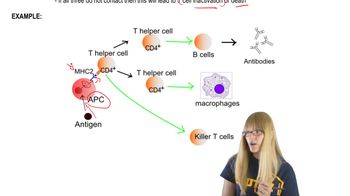
 08:07
08:07