Back

The Light Microscope definitions

Control buttons has been changed to "navigation" mode.
1/13
  • Light Microscope

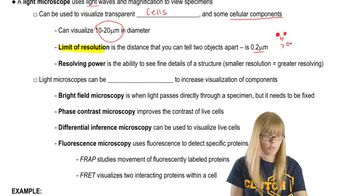
    Instrument using light rays and magnification to visualize transparent cells and cellular compartments up to 10–20 microns in diameter.
  • Magnification

    Process that increases the apparent size of a specimen, allowing for enhanced observation of cellular structures.
  • Limit of Resolution

    Minimum distance between two objects required to distinguish them as separate, typically greater than 0.2 microns.
  • Resolving Power

    Ability to reveal fine structural details, improving as the minimum distinguishable distance decreases.
  • Bright Field Microscopy

    Technique where light passes directly through a fixed specimen, suitable for observing non-living cells.
  • Phase Contrast Microscopy

    Method enhancing contrast in transparent specimens, valuable for visualizing live cells and their structures.
  • Differential Interference Microscopy

    Technique that increases contrast and detail in live cell imaging, allowing better visualization of cellular features.
  • Fluorescent Microscopy

    Approach using fluorescence to detect specific proteins or organelles, enabling targeted visualization within cells.
  • FRAB

    Technique in fluorescence microscopy used to study the movement of proteins within cells.
  • FRET

    Fluorescence-based method for visualizing interactions between two proteins inside a cell.
  • Specimen

    Sample placed under a microscope for observation, often transparent cells or cellular compartments.
  • Cellular Compartment

    Distinct region within a cell, often visualized using advanced microscopy techniques.
  • Fluorescence

    Emission of light by certain substances, used to highlight specific proteins or organelles in microscopy.