Skip to main content
Cell Biology
My Course
Learn
Exam Prep
AI Tutor
Study Guides
Flashcards
Explore
Try the app
My Course
Learn
Exam Prep
AI Tutor
Study Guides
Flashcards
Explore
Try the app
Back
Translation definitions
You can tap to flip the card.
Ribosome
You can tap to flip the card.
👆
Ribosome
Molecular machine made of RNA and protein, composed of large and small subunits, responsible for protein synthesis.
Track progress
Control buttons has been changed to "navigation" mode.
1/15
Related flashcards
Related practice
Recommended videos
Translation quiz #1
Translation
40 Terms
Translation quiz #2
Translation
12 Terms
Translation
5. DNA to RNA to Protein
7 problems
Topic
mRNA Export and Nuclear Structures
5. DNA to RNA to Protein
7 problems
Topic
5. DNA to RNA to Protein - Part 1 of 2
3 topics
9 problems
Chapter
5. DNA to RNA to Protein - Part 2 of 2
3 topics
9 problems
Chapter
Guided course
07:26
Translation Steps
505
views
1
rank
Guided course
02:56
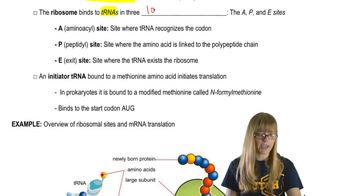
Translation Overview
557
views
3
rank
Guided course
01:12
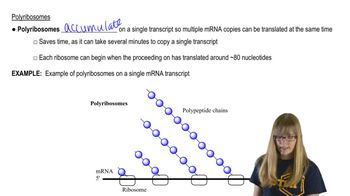
Polyribosomes
421
views
1
rank
Terms in this set (15)
Hide definitions
Ribosome
Molecular machine made of RNA and protein, composed of large and small subunits, responsible for protein synthesis.
tRNA
Adaptor molecule that brings specific amino acids to the ribosome by matching codons on mRNA.
A Site
Ribosomal location where incoming tRNA recognizes and pairs with the mRNA codon.
P Site
Ribosomal location where the growing polypeptide chain is attached to the tRNA.
E Site
Ribosomal location where tRNA, now without an amino acid, exits the ribosome.
Initiator tRNA
Special tRNA carrying methionine that starts protein synthesis by binding the start codon.
Start Codon
AUG sequence on mRNA that signals the beginning of translation and recruits the ribosome.
Elongation Factor
Protein, such as EF-2, that assists the ribosome in adding amino acids and moving along mRNA.
Release Factor
Protein that recognizes stop codons and triggers the release of the completed polypeptide.
Stop Codon
Specific mRNA sequence that signals the end of translation, leading to protein release.
Polypeptide Chain
Linear sequence of amino acids linked together during translation to form a protein.
Shine-Dalgarno Sequence
Prokaryotic mRNA region that aligns the ribosome for translation initiation, replacing the 5' cap.
Polyribosome
Cluster of ribosomes simultaneously translating a single mRNA, increasing protein synthesis efficiency.
5' Cap
Modified nucleotide structure at the mRNA's 5' end in eukaryotes, required for ribosome binding.
Methionine
Amino acid carried by the initiator tRNA, always the first incorporated during eukaryotic translation.
 BackBack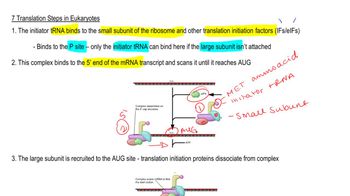
 07:26
07:26