Skip to main content
College Algebra
My Course
Learn
Exam Prep
AI Tutor
Study Guides
Textbook Solutions
Flashcards
Explore
Try the app
My Course
Learn
Exam Prep
AI Tutor
Study Guides
Textbook Solutions
Flashcards
Explore
Try the app
Back
Asymptotes quiz
You can tap to flip the card.
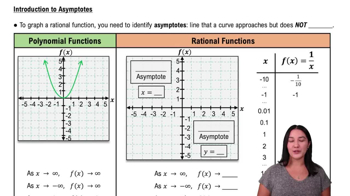
What is an asymptote in the context of rational function graphs?
You can tap to flip the card.
👆
What is an asymptote in the context of rational function graphs?
An asymptote is a line that the graph of a rational function approaches but does not touch, affecting the graph's end behavior.
Track progress
Control buttons has been changed to "navigation" mode.
1/15
Related flashcards
Related practice
Recommended videos
Asymptotes definitions
Asymptotes
15 Terms
Asymptotes
5. Rational Functions
5 problems
Topic
Callie
Graphing Rational Functions
5. Rational Functions
5 problems
Topic
Justin
5. Rational Functions
3 topics
7 problems
Chapter
Callie
Guided course
6:24
Introduction to Asymptotes
3124
views
33
rank
1
comments
Guided course
4:48
Determining Horizontal Asymptotes
1876
views
15
rank
Guided course
3:34
Determining Removable Discontinuities (Holes)
1960
views
22
rank
Terms in this set (15)
Hide definitions
What is an asymptote in the context of rational function graphs?
An asymptote is a line that the graph of a rational function approaches but does not touch, affecting the graph's end behavior.
How do you find the vertical asymptotes of a rational function?
Set the denominator equal to zero and solve for x after writing the function in lowest terms.
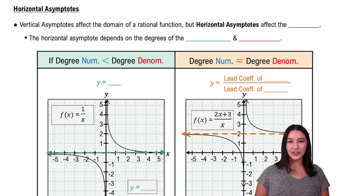
What is the horizontal asymptote for the function f(x) = 1/x?
The horizontal asymptote is y = 0 because the degree of the numerator is less than the degree of the denominator.
How do you determine the horizontal asymptote when the degrees of the numerator and denominator are equal?
Divide the leading coefficient of the numerator by the leading coefficient of the denominator to find the horizontal asymptote.
What happens to the graph of f(x) = 1/x as x approaches infinity?
The graph approaches the horizontal asymptote y = 0 as x approaches infinity or negative infinity.
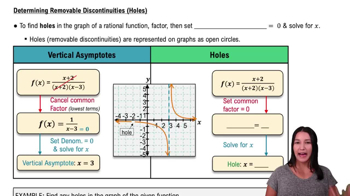
How can you identify a hole in the graph of a rational function?
Set the common factor that cancels in both the numerator and denominator equal to zero and solve for x; this x-value is where the hole occurs.
What is a removable discontinuity in a rational function graph?
A removable discontinuity is another term for a hole, which occurs when a common factor is canceled from the numerator and denominator.
Can a rational function have more than one vertical asymptote?
Yes, a rational function can have multiple vertical asymptotes depending on the factors in its denominator.
What is the vertical asymptote for f(x) = 1/(x^2 - 9)?
The vertical asymptotes are at x = 3 and x = -3, found by setting x^2 - 9 = 0.
How do you find the hole for f(x) = (x+3)/(x^2+4x+3)?
Factor the denominator to get (x+3)(x+1), set the common factor x+3 = 0, and solve for x to get a hole at x = -3.
What is the horizontal asymptote for f(x) = 4x^2/(-x^3 - 5x + 9)?
The horizontal asymptote is y = 0 because the degree of the numerator (2) is less than the degree of the denominator (3).
What is the horizontal asymptote for f(x) = 2x^2/(3x^2 + x - 1)?
The horizontal asymptote is y = 2/3, which is the ratio of the leading coefficients since the degrees are equal.
Can a graph of a rational function cross its horizontal asymptote?
Yes, a graph can cross its horizontal asymptote, but it will still approach the asymptote as x goes to infinity or negative infinity.
What is the effect of vertical asymptotes on the domain of a rational function?
Vertical asymptotes indicate values of x that are excluded from the domain because they make the denominator zero.
What is the effect of horizontal asymptotes on the range of a rational function?
Horizontal asymptotes affect the range by indicating the y-value the function approaches as x goes to infinity or negative infinity.
 BackBack

 6:24
6:24