Skip to main content
College Algebra
My Course
Learn
Exam Prep
AI Tutor
Study Guides
Textbook Solutions
Flashcards
Explore
Try the app
My Course
Learn
Exam Prep
AI Tutor
Study Guides
Textbook Solutions
Flashcards
Explore
Try the app
Back
Function Composition quiz
You can tap to flip the card.
What does it mean to compose two functions, such as f(g(x))?
You can tap to flip the card.
👆
What does it mean to compose two functions, such as f(g(x))?
Composing two functions means replacing the variable in one function with another function, resulting in a new function.
Track progress
Control buttons has been changed to "navigation" mode.
1/15
Related flashcards
Related practice
Recommended videos
Function Composition definitions
Function Composition
15 Terms
Function Composition
3. Functions
6 problems
Topic
Callie
Function Operations
3. Functions
6 problems
Topic
Justin
3. Functions
5 topics
13 problems
Chapter
Callie
Guided course
4:26
Evaluating Composed Functions
2416
views
43
rank
Guided course
1:46
Decomposition of Functions Example 1
1944
views
45
rank
Guided course
3:51
Domain Restrictions of Composed Functions
2106
views
24
rank
Terms in this set (15)
Hide definitions
What does it mean to compose two functions, such as f(g(x))?
Composing two functions means replacing the variable in one function with another function, resulting in a new function.
If f(x) = x^2 + 3x - 10 and g(x) = x - 2, what is f(g(x))?
f(g(x)) = (x - 2)^2 + 3(x - 2) - 10, which simplifies to x^2 - x - 12.
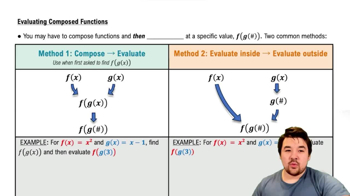
How do you evaluate a composed function at a specific value using the two-step method?
First, evaluate the inner function at the given value, then substitute this result into the outer function.
What is the shortcut method for evaluating f(g(a))?
Evaluate g(a) first, then plug that result into f(x) to get f(g(a)).
Why might you not always use the shortcut method for evaluating composed functions?
Because sometimes you are required to find the general form of f(g(x)) before substituting a value.
If f(x) = x + 4 and g(x) = x^2 - 3, what is f(g(x))?
f(g(x)) = (x^2 - 3) + 4 = x^2 + 1.
If f(x) = x + 4 and g(x) = x^2 - 3, what is g(f(x))?
g(f(x)) = (x + 4)^2 - 3, which expands to x^2 + 8x + 16 - 3 = x^2 + 8x + 13.
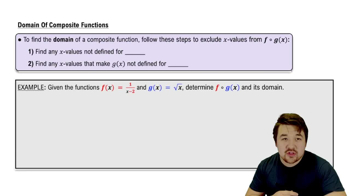
How do you find the domain of a composed function f(g(x))?
Find the domain restrictions for both g(x) and f(g(x)), then combine these restrictions for the overall domain.
If f(x) = 1/(x-2) and g(x) = sqrt(x), what is the domain of f(g(x))?
The domain is all x ≥ 0 except x ≠ 4, so [0, 4) ∪ (4, ∞).
Why must you consider the domain of both the inner and outer functions when composing functions?
Because the input must be valid for the inner function and the result must be valid for the outer function.
What is function decomposition?
Function decomposition is expressing a single function as the composition of two functions, f and g.
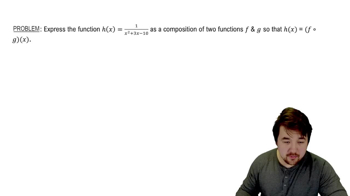
Given h(x) = sqrt(x - 2), how can you decompose h(x) into f(g(x))?
Let g(x) = x - 2 and f(x) = sqrt(x), so h(x) = f(g(x)).
Is there only one correct way to decompose a function?
No, there are multiple correct ways to decompose a function, depending on how you define f(x) and g(x).
What is a common strategy for decomposing a function involving a square root?
Set g(x) equal to the expression inside the square root and f(x) equal to the square root function.
How can creativity play a role in function decomposition?
You can choose different expressions for g(x) and adjust f(x) accordingly, as long as their composition gives the original function.
 BackBack

 4:26
4:26