Back

Graphing Exponential Functions quiz

Control buttons has been changed to "navigation" mode.
1/15
  • What is the value of 2^0 and why?

    2^0 equals 1 because any number raised to the power of 0 is 1.
  • What happens to the value of 2^x as x increases?

    As x increases, 2^x increases rapidly, approaching infinity.
  • What is the horizontal asymptote for the function 2^x?

    The horizontal asymptote is y = 0, which the function approaches but never touches as x becomes negative.
  • What is the domain of any exponential function like 2^x?

    The domain is all real numbers, from negative infinity to positive infinity.
  • How do you determine the range of an exponential function like 2^x?

    The range depends on the asymptote; for 2^x, it is (0, infinity), not including 0.
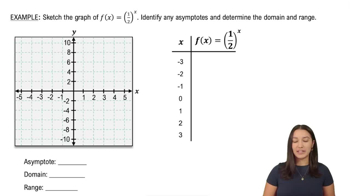
  • What effect does the base b have on the direction of the graph of b^x?

    If b > 1, the graph increases; if 0 < b < 1, the graph decreases.
  • How does the steepness of the graph change as the base b increases for b > 1?

    The graph becomes steeper for larger values of b when b > 1.
  • What happens to the steepness of the graph for bases between 0 and 1?

    For 0 < b < 1, the graph gets steeper as b gets smaller.
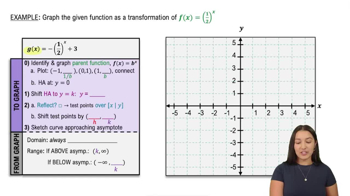
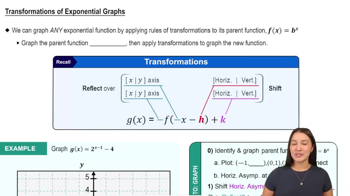
  • What is the parent function for g(x) = 2^(x-1) - 4?

    The parent function is f(x) = 2^x.
  • What does a negative sign outside an exponential function indicate?

    A negative sign outside the function indicates a reflection over the x-axis.
  • What does a negative sign inside the exponent of an exponential function indicate?

    A negative sign inside the exponent indicates a reflection over the y-axis.
  • How do you identify the horizontal shift in a function like 2^(x-1)?

    The horizontal shift is h units to the right, where h is the value subtracted from x.
  • How do you identify the vertical shift in a function like 2^x - 4?

    The vertical shift is k units down, where k is the value subtracted from the function.
  • After applying transformations, what happens to the domain of an exponential function?

    The domain remains all real numbers, regardless of transformations.
  • How does the range of a transformed exponential function change with a vertical shift?

    The range starts from the new asymptote (k) to infinity if the graph is above the asymptote.