What is the parent rational function commonly used for transformations?
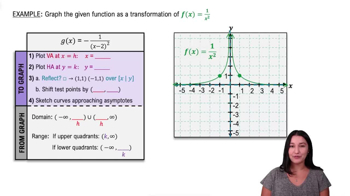
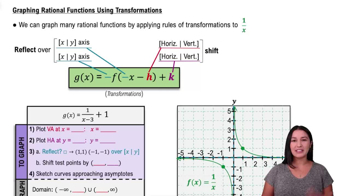
The parent rational function is 1/x. Transformations are applied to this function to graph more complex rational functions.
How do you identify the vertical asymptote when graphing a transformed rational function?
The vertical asymptote is found at x = h, where h is the value subtracted from x in the denominator. It is plotted as a dashed line.
Where is the horizontal asymptote located in a transformed rational function?
The horizontal asymptote is at y = k, where k is the constant added outside the rational expression. It is also plotted as a dashed line.
What does a negative sign outside the function indicate in terms of transformations?
A negative outside the function indicates a reflection over the x-axis. If the negative is inside, it reflects over the y-axis.
How do you shift test points when graphing a transformed rational function?
Test points are shifted by h units horizontally and k units vertically. For example, (1,1) becomes (h+1, k+1).
How do you sketch the curves of a rational function after applying transformations?
Sketch the curves so they approach the vertical and horizontal asymptotes, using the shifted test points as reference.
How is the domain of a transformed rational function expressed in set notation?
The domain is written as (-∞, h) ∪ (h, ∞), where h is the vertical asymptote. Parentheses indicate h is not included.
How is the range of a transformed rational function expressed in set notation?
The range is written as (-∞, k) ∪ (k, ∞), where k is the horizontal asymptote. Parentheses show k is not included.
What is the first step when graphing a rational function from scratch?
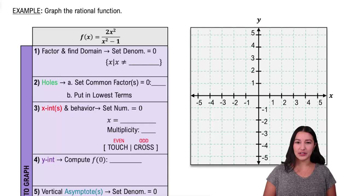
The first step is to factor the function and find the domain by setting the denominator equal to zero.
How do you find the x-intercept of a rational function?
Set the numerator equal to zero and solve for x. The x-intercept is where the graph crosses the x-axis.
How do you determine the y-intercept of a rational function?
Plug x = 0 into the function and solve for y. The result is the y-intercept.
How do you find the vertical asymptote of a rational function?
Set the denominator equal to zero and solve for x. The solution is the location of the vertical asymptote.
How do you determine the horizontal asymptote when the degrees of the numerator and denominator are equal?
Divide the leading coefficients of the numerator and denominator. The result is the horizontal asymptote y = (numerator coefficient)/(denominator coefficient).
How do you analyze the behavior of a rational function between known components?
Divide the graph into intervals based on vertical asymptotes and x-intercepts, then plot points within each interval to determine behavior.
What is the final step in graphing a rational function after plotting points and asymptotes?
Connect the plotted points and ensure the curves approach the asymptotes, completing the graph.
 Back
Back

 5:31
5:31