Back

Radical Expressions quiz

Control buttons has been changed to "navigation" mode.
1/15
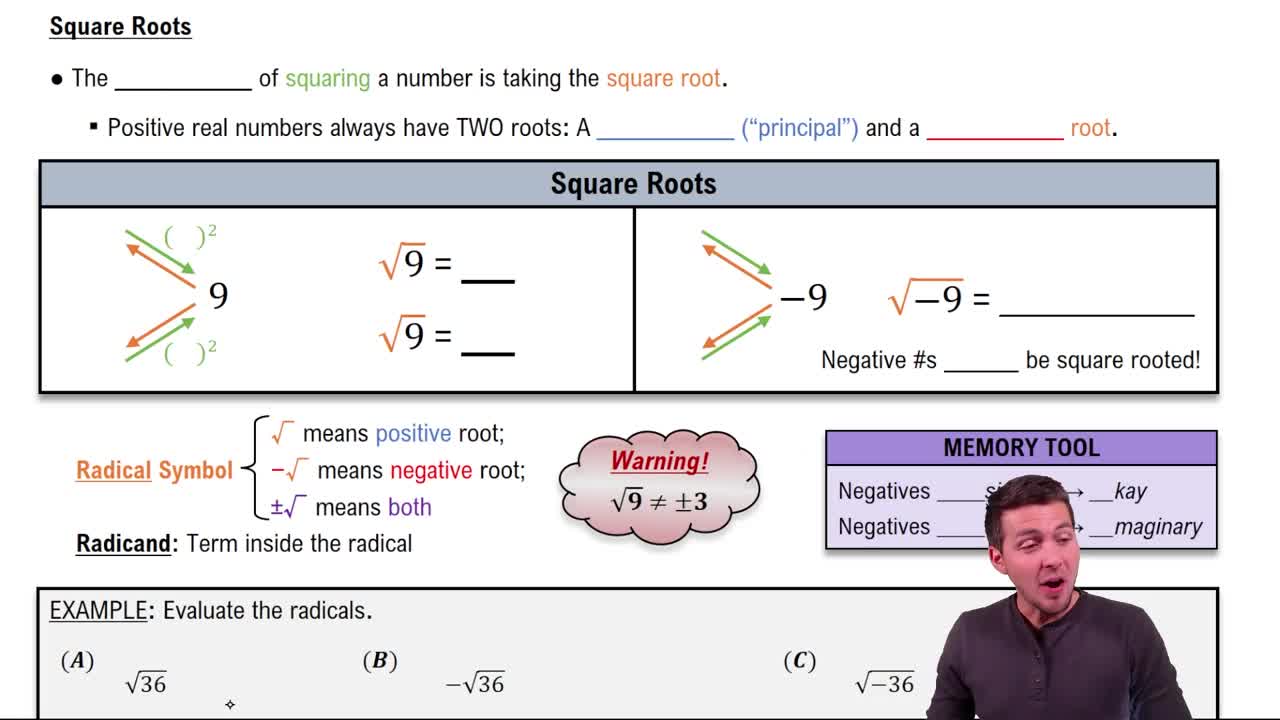
  • What is the relationship between squaring a number and taking its square root?

    Squaring and taking the square root are opposites; squaring a number gives you a result, and the square root finds the original number.
  • How many square roots does a positive real number have?

    A positive real number has two square roots: a positive (principal) root and a negative root.
  • What does the radical symbol by itself indicate?

    The radical symbol by itself indicates the principal (positive) root.
  • How do you denote the negative square root of a number?

    You place a minus sign in front of the radical symbol to indicate the negative root.
  • What happens if you see a negative sign inside the radical symbol for a square root?

    A negative inside the radical for a square root means the answer is imaginary.
  • Is it possible to take the square root of a negative number and get a real answer?

    No, the square root of a negative number is not real; it is imaginary.
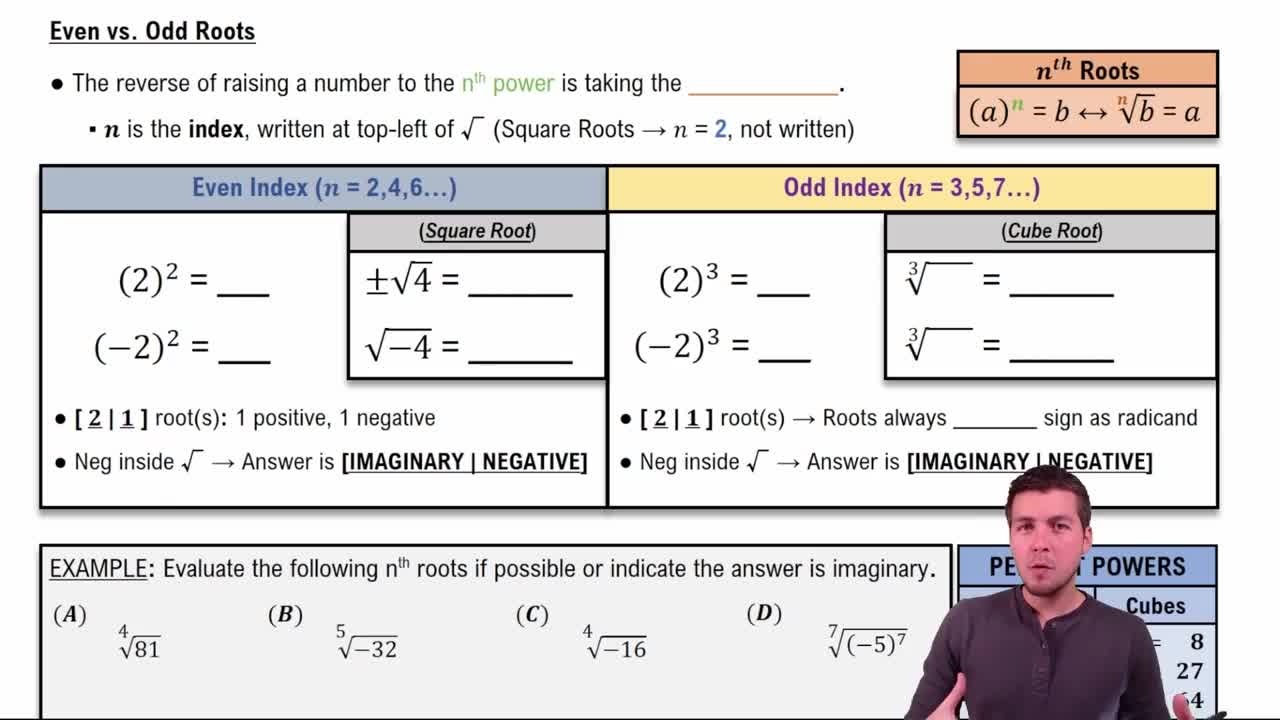
  • How many cube roots does a number have?

    A number has only one cube root, and its sign matches the sign of the original number.
  • Can you take the cube root of a negative number?

    Yes, the cube root of a negative number is a negative real number.
  • What is the nth root of a number?

    The nth root is the opposite of raising a number to the power of n; it finds the original number.
  • What is the index in a radical expression?

    The index is the small number written at the top left of the radical, indicating which root to take.
  • What is the invisible index for square roots?

    The index for square roots is 2, but it is usually not written.
  • What happens when you have an even index and a negative number inside the radical?

    With an even index and a negative radicand, the answer is imaginary.
  • What happens when you have an odd index and a negative number inside the radical?

    With an odd index and a negative radicand, the answer is a negative real number.
  • What is the shortcut when the exponent matches the index in a radical expression?

    If the exponent equals the index, the radical and exponent cancel, leaving just the base.
  • How do you determine if a root is real or imaginary based on the index and radicand?

    Check if the index is even or odd; even index with negative radicand is imaginary, odd index with negative radicand is real.