Skip to main content
College Algebra
My Course
Learn
Exam Prep
AI Tutor
Study Guides
Textbook Solutions
Flashcards
Explore
Try the app
My Course
Learn
Exam Prep
AI Tutor
Study Guides
Textbook Solutions
Flashcards
Explore
Try the app
Back
Sequences quiz
You can tap to flip the card.
What is a sequence in mathematics?
You can tap to flip the card.
👆
What is a sequence in mathematics?
A sequence is an ordered list of numbers, where each number is called a term or element of the sequence.
Track progress
Control buttons has been changed to "navigation" mode.
1/15
Related flashcards
Related practice
Recommended videos
Sequences definitions
Sequences
15 Terms
Sequences
9. Sequences, Series, & Induction
5 problems
Topic
Callie
Arithmetic Sequences
9. Sequences, Series, & Induction
4 problems
Topic
Callie
9. Sequences, Series, & Induction
3 topics
6 problems
Chapter
Callie
4:19
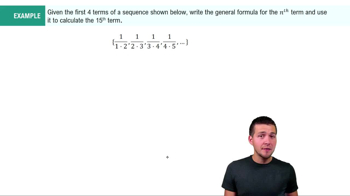
Example 2
895
views
2
rank
5:52
Example 1
942
views
2
rank
8:22
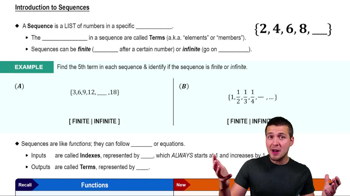
Introduction to Sequences
1169
views
9
rank
1
comments
Terms in this set (15)
Hide definitions
What is a sequence in mathematics?
A sequence is an ordered list of numbers, where each number is called a term or element of the sequence.
How do you determine if a sequence is finite or infinite?
A sequence is finite if it has a definite end, and infinite if it continues indefinitely, often indicated by '...'.
What is the difference between a function and a sequence regarding their inputs?
Functions can take any real number as input, while sequences only take positive integers as inputs, called indexes.
How do you find the nth term of a sequence using a general (explicit) formula?
You substitute the value of n into the explicit formula to calculate the nth term directly.
What is a recursive formula for a sequence?
A recursive formula defines each term based on one or more previous terms in the sequence, rather than directly using n.
How do you find the next term in a sequence using a recursive formula?
You use the previous term(s) and apply the recursive rule to calculate the next term.
What pattern do arithmetic sequences follow?
Arithmetic sequences have a constant difference between consecutive terms, such as adding the same number each time.
How can you recognize a sequence with alternating signs?
A sequence with alternating signs often uses (-1) raised to the n or (n+1) power in its formula.
What does the formula a_n = n/(n+1) generate as a sequence?
It generates a sequence where the numerator increases by 1 each time, and the denominator is always one more than the numerator.
How do you adjust a general formula if the first term does not match the index?
You add, subtract, multiply, or divide by a constant to shift the formula so the first term matches the sequence.
What type of sequence is represented by a_n = 2^n?
This is an exponential sequence, where each term is a power of 2.
Why might a recursive formula be preferred over an explicit formula?
A recursive formula is often easier to use when you only need the next few terms and the explicit formula is hard to find.
How do you find the first three terms of the sequence a_n = n^2?
Plug in n = 1, 2, and 3 to get 1, 4, and 9 as the first three terms.
What does the notation a_n-1 mean in a recursive formula?
It refers to the previous term in the sequence, the term immediately before a_n.
How do you find the next term in the sequence defined by a_1 = 1 and a_n = n * a_n-1?
Multiply the current index n by the previous term to get the next term; for example, a_2 = 2 * a_1 = 2.
 BackBack
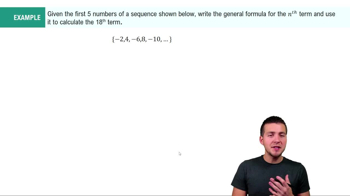
 4:19
4:19