Financial Accounting
My Course
Learn
Exam Prep
AI Tutor
Study Guides
Flashcards
Explore
My Course
Learn
Exam Prep
AI Tutor
Study Guides
Flashcards
Explore
Back
Revenue Recognition and Expense Recognition definitions
2 students found this helpful
You can tap to flip the card.
Revenue
You can tap to
flip the card.
👆
Revenue
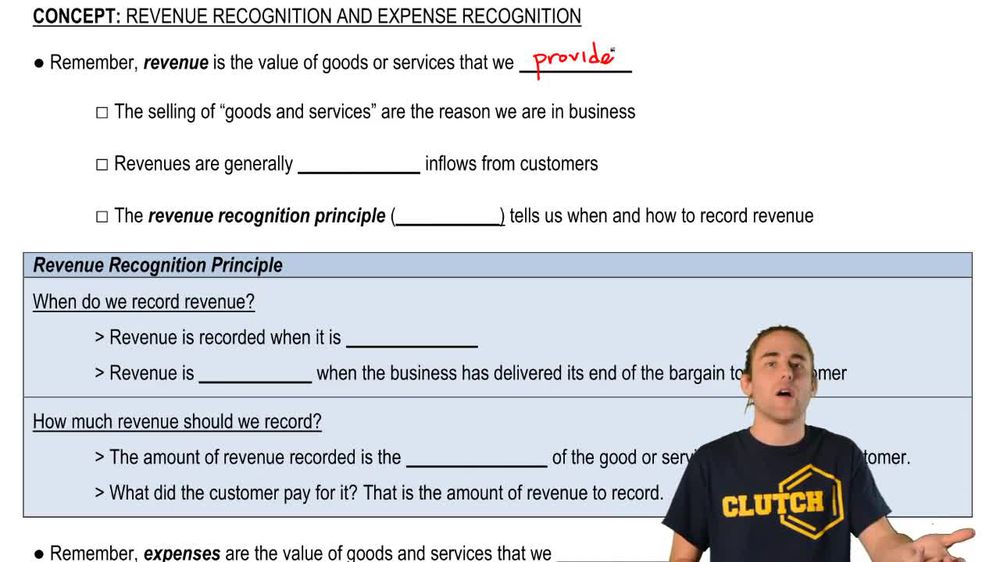
Value received from providing goods or services central to a company's main business activities.
Track progress
Control buttons has been changed to "navigation" mode.
1/15
Related flashcards
Related practice
Recommended videos
Guided course
03:24
Revenue Recognition Principle
Brian
4023
views
105
rank
1
comments
Guided course
04:18
Expense Recognition - The Matching Principle
Brian
3151
views
71
rank
Terms in this set (15)
Hide definitions
Revenue
Value received from providing goods or services central to a company's main business activities.
Expense
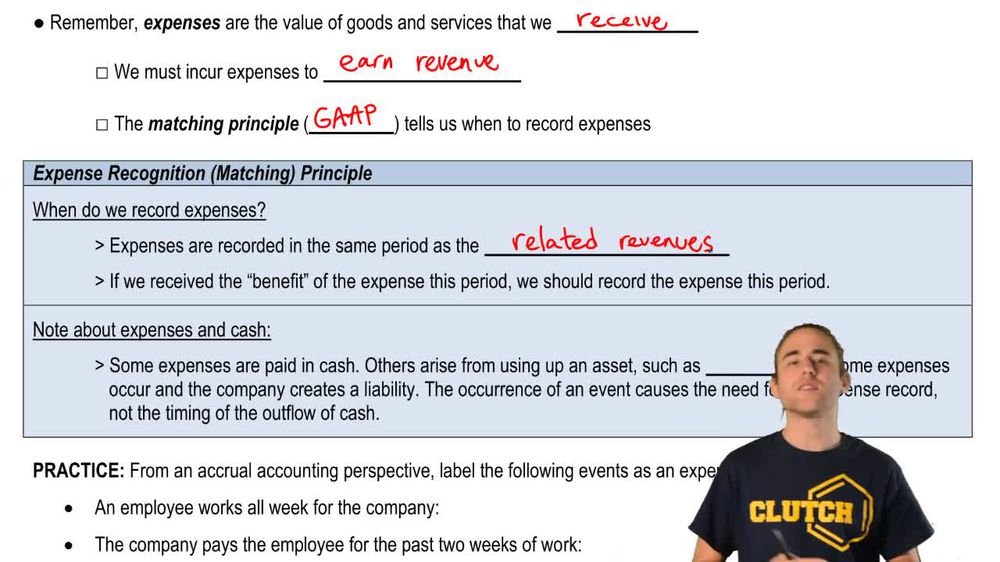
Value of goods or services consumed or received to help generate revenue during a period.
GAAP
Set of standardized accounting rules in the U.S. guiding when and how financial transactions are recorded.
Revenue Recognition Principle
Guideline requiring income to be recorded when goods or services are delivered, regardless of payment timing.
Matching Principle
Rule requiring costs to be recorded in the same period as the revenues they help produce.
Accrual Accounting
Method where transactions are recorded when earned or incurred, not necessarily when cash changes hands.
Cash Basis Accounting
System where transactions are recorded only when cash is received or paid.
Accounts Receivable
Amounts owed by customers for goods or services already delivered but not yet paid for.
Liability
Obligation to pay for goods or services already received, often arising when payment is deferred.
Asset
Resource owned or controlled by a company, such as supplies, that can provide future economic benefit.
Cash Inflow
Money received by a business, typically from customers in exchange for goods or services.
Transaction
Economic event involving the exchange of goods, services, or obligations between parties.
Period
Specific span of time, such as a month or year, used for reporting financial results.
Benefit
Advantage or value received from goods or services, determining when expenses should be recorded.
Supplies
Consumable items used in operations, recognized as expenses when utilized during a reporting period.