
Textbook Question
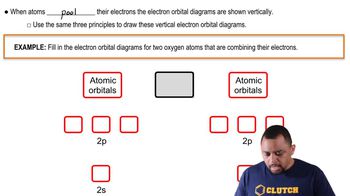
a) Using only the valence atomic orbitals of a hydrogen
atom and a fluorine atom, and following the model of
Figure 9.46, how many MOs would you expect for the HF
molecule?
648
views

 Verified step by step guidance
 01:51
01:51
 00:51
00:51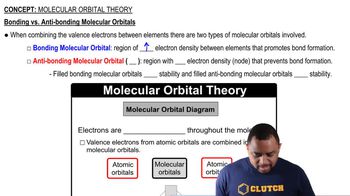 03:06
03:06The energy-level diagram in Figure 9.36 shows that the sideways overlap of a pair of p orbitals produces two molecular orbitals, one bonding and one antibonding. In ethylene there is a pair of electrons in the bonding π orbital between the two carbons. Absorption of a photon of the appropriate wavelength can result in promotion of one of the bonding electrons from the p2p to the p*2p molecular orbital. (b) Assuming this electronic transition corresponds to the HOMO-LUMO transition, what is the LUMO in ethylene?
(b) How many of the MOs from part (a) would be occupied by electrons?
Azo dyes are organic dyes that are used for many applications, such as the coloring of fabrics. Many azo dyes are derivatives of the organic substance azobenzene, C12H10N2. A closely related substance is hydrazobenzene, C12H12N2. The Lewis structures of these two substances are
(Recall the shorthand notation used for benzene.) (c) Predict the N¬N¬C angles in each of the substances.
The energy-level diagram in Figure 9.36 shows that the sideways overlap of a pair of p orbitals produces two molecular orbitals, one bonding and one antibonding. In ethylene there is a pair of electrons in the bonding π orbital between the two carbons. Absorption of a photon of the appropriate wavelength can result in promotion of one of the bonding electrons from the p2p to the p*2p molecular orbital. (a) Assuming this electronic transition corresponds to the HOMO-LUMO transition, what is the HOMO in ethylene?
Carbon monoxide, CO, is isoelectronic to N2. (d) Would you expect the p2p MOs of CO to have equal atomic orbital contributions from the C and O atoms? If not, which atom would have the greater contribution?