Back

Alpha Decay quiz

Control buttons has been changed to "navigation" mode.
1/15
  • What is an alpha particle composed of?

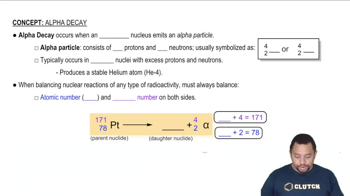
    An alpha particle consists of 2 protons and 2 neutrons, making it equivalent to a helium-4 nucleus.
  • How is an alpha particle represented in nuclear equations?

    It can be represented as either the alpha symbol (α) or as helium-4 (⁴₂He).
  • Why do heavy nuclei undergo alpha decay?

    Heavy nuclei undergo alpha decay to become more stable by emitting an alpha particle.
  • What must be balanced on both sides of a nuclear reaction equation?

    Both the mass number (total protons and neutrons) and the atomic number (protons) must be balanced.
  • What is the atomic number and mass number of an alpha particle?

    The atomic number is 2 and the mass number is 4.
  • In the decay of platinum-171, what are the products?

    The products are osmium-167 and an alpha particle.
  • How do you determine the new element formed after alpha decay?

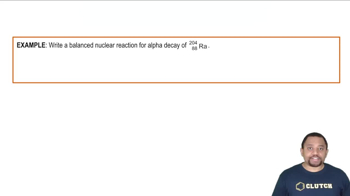
    Subtract 2 from the atomic number and 4 from the mass number of the original element.
  • What is the ionizing power of alpha particles compared to other energetic particles?

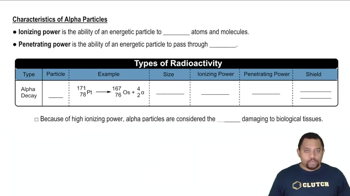
    Alpha particles have the highest ionizing power among energetic particles.
  • Why do alpha particles have low penetrating power?

    Because they are large and heavy, making it difficult for them to pass through matter.
  • What materials can shield against alpha particles?

    Clothing, paper, skin, and even air can shield against alpha particles.
  • Why are alpha particles dangerous if ingested or inhaled?

    Once inside the body, their high ionizing power can cause significant damage to biological tissues.
  • What is the main safety concern with alpha particles in a nuclear facility?

    The main concern is ingestion or inhalation, as external exposure is not dangerous due to low penetration.
  • What is the atomic number of osmium, the product in the platinum-171 alpha decay?

    Osmium has an atomic number of 76.
  • How does the size of an alpha particle affect its movement and ionizing ability?

    Its large size makes it move slowly, giving it more time to ionize molecules in biological tissue.
  • What is the relationship between the atomic number and the identity of an element?

    The atomic number, which is the number of protons, uniquely identifies the element.