Back

Amide Formation quiz

Control buttons has been changed to "navigation" mode.
1/15
  • What two types of molecules react to form an amide in amide formation?

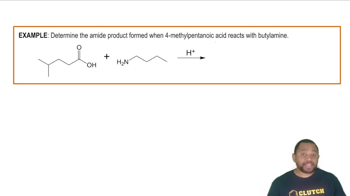
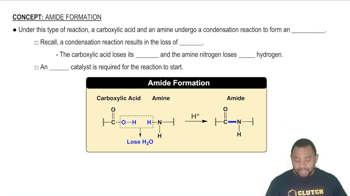
    A carboxylic acid and an amine react to form an amide.
  • What is lost during the condensation reaction that forms an amide?

    Water is lost during the condensation reaction.
  • Which group is removed from the carboxylic acid during amide formation?

    The hydroxyl group (OH) is removed from the carboxylic acid.
  • What is removed from the amine during amide formation?

    One hydrogen atom is removed from the amine.
  • What catalyst is required to initiate amide formation?

    An H+ (acid) catalyst is required to start the reaction.
  • What type of bond forms between the carboxylic acid and amine in an amide?

    A bond forms between the carbon of the carboxylic acid and the nitrogen of the amine.
  • What is the structural feature of an amide?

    An amide has a carbonyl group (C=O) single-bonded to a nitrogen atom.
  • Why must the nitrogen in the amine have at least one hydrogen for amide formation?

    The nitrogen needs at least one hydrogen so it can be removed to form water.
  • What is the general outcome of a condensation reaction between a carboxylic acid and an amine?

    The outcome is the formation of an amide and water.
  • What happens to the carbon and nitrogen after water is lost in amide formation?

    The carbon and nitrogen bond to each other to form the amide.
  • What is the role of the H+ catalyst in amide formation?

    The H+ catalyst initiates or jump-starts the reaction.
  • What is the significance of amide formation in organic chemistry?

    Amide formation is essential for synthesizing amides, which are common in organic and biological molecules.
  • What does the squiggly line in the reaction diagram represent?

    The squiggly line indicates the molecule is connected to something else not relevant to the reaction.
  • What is the product besides the amide in the amide formation reaction?

    Water is produced as a byproduct.
  • How does the condensation reaction mechanism ensure the formation of an amide?

    By removing the OH from the acid and H from the amine, the carbon and nitrogen can bond, forming an amide.